
Loading…
Rotate for the best fullscreen experience
Bieqi, also written Spade 7, is a four-player card game from northern China. Each player gets 13 cards and the 7 of spades opens. Every suit grows from its 7, down to the ace and up to the king. You must play if you can; otherwise you fold one card face down. After all 52 cards are gone, folded cards count as penalty points and the fewest points wins.
At a glance
| Players | 4 |
|---|---|
| Decks | 1 |
| Jokers | No |
| Difficulty | Medium |
| Computer opponents | Yes |
How to play
Cards and the deal
Bieqi uses a standard 52-card deck with no jokers. The cards are shuffled and dealt out completely, 13 to each of the four players. There is no kitty and no bidding. You sit at the bottom of the table; the three computer opponents sit to your left, across from you and to your right.
Suits have no ranking. They only decide which of the four rows a card belongs to. Ranks are not compared during play either: the only question on your turn is whether a card fits onto the layout. Ranks matter only at the end, when folded cards are turned into penalty points.
Who starts
The player holding the 7 of spades goes first, and the first card of the game must be the 7♠. That player may not play anything else and may not fold. Once the 7♠ is down, the spade row exists in the middle of the table. Play then moves around the table in seat order. On every turn a player does exactly one thing: play one card or fold one card. There is no passing in Bieqi.
Opening rows and building on them
The middle of the table has room for four rows, one per suit, and all four start empty.
- Opening a row: while a suit has no row yet, the only card of that suit you can play is its 7. Playing the 7 opens the row. After the 7♠, any 7 can be played at any time; there is no rule about which suit has to be opened next.
- Building: once a row is open, cards can only be added at its two ends. The card one rank below the lowest card goes on the low end, and the card one rank above the highest goes on the high end, always in the same suit. For example, if the hearts row runs from 5 to 9, only the 4♥ and the 10♥ can be played there. The 3♥ and the J♥ have to wait.
- End points: going down, a row runs 7-6-5-4-3-2-A; going up, it runs 7-8-9-10-J-Q-K. The ace is the lowest card and closes the low end, and the king closes the high end. The two ends never join, so nothing goes above the king.
- While a suit is still unopened, its 6 and 8 cannot be played.
A card you are allowed to play is called a live card: either the 7 of a suit that has not been opened, or a card that fits on one end of an open row.
Play if you can, fold if you cannot
When it is your turn and you hold any live card, you must play one. You choose which one, but you may not fold on purpose and you may not pass.
When you hold no live card at all, you are blocked, and you must fold one card of your choice. A folded card goes face down in front of you. It never reaches the table, and the other players only see how many cards you have folded, never which ones. Choosing what to fold is the most important decision in the game.
A folded card is gone for good. If someone folds the 4♥, the hearts row stops at 5 on its low end forever, and anyone holding the 3♥, 2♥ or A♥ will never be able to play them. Those cards can only be folded later.
When the game ends
Every turn removes exactly one card from a hand, and everyone takes turns in order, so all four hands shrink together. A player who plays their last card does not end the game early. The game ends only after all four players have played or folded all 13 cards, which is after the 52nd turn. The table can never get stuck, because a player who cannot play always has a card to fold.
Penalty points and winning
At the end, everyone's folded cards are revealed. Your penalty is the total rank of the cards you folded: an ace counts 1, the 2 to 10 count their face value, a jack counts 11, a queen 12 and a king 13. A player who folded nothing has a penalty of 0, and the result panel marks them as Clean.
The lowest penalty wins. If several players tie for the lowest penalty, they all win. Players are ranked from lowest to highest penalty, and equal penalties share a place.
Scores are settled by the difference in penalties between every pair of players: your score is the sum of all four penalties minus four times your own penalty, so the four scores always add up to zero. For example, with penalties of 0, 5, 5 and 12, the total is 22 and the scores are 22, 2, 2 and −26; the player who folded nothing wins. With penalties of 3, 3, 8 and 10, the first two players share first place and both win, scoring 12, 12, −8 and −16.
About this game
The game where you get stuck on the sevens
Bieqi is a well-known card game in northern China. The name roughly means "stuck sevens": the tense moment of the game is the turn when nothing in your hand fits, and you have to fold a card and take the penalty. In English it is often written Spade 7, because every game opens with the 7 of spades.
The layout will look familiar if you know Fan Tan, also called Sevens: four rows that start from the 7 of each suit and grow outward one card at a time. The goal, however, is completely different. In Fan Tan you may pass when you cannot play, and the first player to empty their hand wins. In Bieqi there is no passing. When you are blocked you must fold, the game is not a race, and in the end only the points you folded count. Because folded cards never come back, a single card folded in the right place can freeze a whole row for the rest of the game.
The rules take a few minutes to explain, but every turn involves a trade-off. Which live card opens a path for your opponents? Which card can you keep to block them? And when you are stuck, which fold costs you the least? Hands and folds stay hidden while the layout in the middle is public, so reading the table is the same as reading your opponents.
Playing on this site
Open the page and play right away. There is nothing to download and no account to create, and the game works in portrait or landscape on a phone as well as in a desktop browser. You play against three computer opponents, who come in three difficulty levels: Easy, Medium and Hard.
- Live cards stand out: on your turn, cards you can play look normal, while cards that do not fit yet are dimmed but still visible. Your hand is sorted by suit.
- Select, then play: tap a live card, then press Play. If you try a card that does not fit, the game explains why, for example that the row is not open and needs its 7 first, or that the card does not touch either end. The table does not change.
- Folding is your choice: when you are blocked, the game never folds for you. A prompt above your hand says there is no play and asks you to pick a card to fold. Every card in your hand can be selected, the selected card shows how many penalty points it would cost, and you confirm with the Fold button.
- Hint: when you are unsure, press Hint. If you can play, it suggests a live card; if you must fold, it suggests which card to fold.
- Folds you can follow: each seat has a small face-down pile showing how many cards that player has folded, and a seat briefly shows "Fold" when its player folds. Your own fold tray shows how many cards you have folded and your current penalty, and you can open it to see every card you folded.
- A clear result: the result panel reveals every player's folded cards and lists penalties, scores and places, with a mark for any Clean player. Play again starts a new deal straight away.
- Skip and fast-forward: you can skip the deal animation and speed up a run of computer turns.
- Autosave: reload the page, rotate your phone or go in and out of full screen, and the game continues where you left it, including your folded cards and penalty.
There is no undo. The cards you play and the moments you fold are information your opponents have already used. The layout shows every card that has been played, and folds are hidden by the rules, so there is no separate card counter. Each game is scored on its own, with no multipliers and no running total between games.
Strategy tips
When you are blocked, fold low cards. Penalties follow rank, so folding an ace costs 1 point while folding a king costs 13. If several cards are unlikely to be played anyway, the lowest one is usually the right fold.
Fold the cards you will never play. If a row is blocked by someone else, or the card you need has probably been folded already, the rest of that suit is dead weight in your hand. Fold those first when you are stuck, and keep cards that are about to become playable.
Sevens, sixes and eights are gates. While you hold the 7 of a suit, nobody can play any card of that suit. Holding the 6 or the 8 means the row cannot grow in that direction until you allow it. If your own cards sit behind the gate, open it early to make a path for yourself. If only your opponents' cards are behind it, keep it closed as long as you can, so they are the ones forced to fold, ideally their high cards. Remember that you must play a live card if you have one, so a gate that is your only live card has to go.
Prefer cards that lead to your own cards. When you have a choice of live cards, play the one that opens a path for the rest of your hand. If you hold the 9, 10 and J of clubs, playing the 8♣ lets you keep building on your next turns.
Find a way out for your high cards. A jack, queen or king that you are forced to fold is an expensive penalty. If a suit where you hold high cards is growing upward, watch that row closely and make sure you are not left folding them at the end.
Watch who folds. A player who folds had none of the cards that were playable at that moment. Keep track of those folds and you will get a good idea of who is blocking which row, and which cards may already be folded and will never appear.
Bieqi · FAQ
Do you have to start Bieqi with the 7 of spades?
Yes. The player holding the 7 of spades goes first, and that first card must be the 7♠. They cannot play another card or fold. After that, play continues in seat order and any 7 can be played at any time.
Can you fold in Bieqi when you have a card you could play?
No. If you hold any live card, you must play one, although you choose which. You may not fold on purpose and you may not pass. You only fold when no card in your hand fits the layout.
Can you pass in Bieqi?
No. Bieqi has no passing at all. On each turn you either play a live card or, if you have none, fold a card face down, so every player takes exactly 13 turns.
How are folded cards scored in Spade 7?
Folded cards count their rank as penalty points: an ace is 1, the 2 to 10 are face value, and the jack, queen and king are 11, 12 and 13. Your penalty is the total of all your folded cards, and the lowest penalty wins.
How are the final scores worked out in Bieqi?
Your score is the sum of all four penalties minus four times your own penalty. This is the same as settling the difference in penalties with each of the other three players, so the scores add up to zero. Penalties of 0, 5, 5 and 12 give scores of 22, 2, 2 and −26.
What happens if players tie in Bieqi?
Tied players share the same place. If several players tie for the lowest penalty, they all win and get the same score. With penalties of 3, 3, 8 and 10, the first two players share first place and score 12 each.
Is the ace high or low in Spade 7?
The ace is low and counts 1 point. Each row goes down to the ace and up to the king, and the two ends never join, so nothing can be played above the king.
Does Bieqi end when one player runs out of cards?
No. Bieqi is not a race. The game ends only after all four players have played or folded all 13 cards. Because every turn removes one card from a hand, all four players run out during the same round.
What does Clean mean in Bieqi?
A Clean player finished the game without folding a single card, so their penalty is 0. On this site a Clean player is marked in the result panel, but there is no extra multiplier; scores are settled by penalty differences as usual.
How is Bieqi different from Fan Tan?
Both use the same layout, with rows built outward from the sevens, but the goals differ. In Fan Tan you pass when you cannot play and the first player out wins. In Bieqi you cannot pass, you must fold a card when you are blocked, and the lowest total of folded points wins once every card is gone. Bieqi on this site also starts with the 7 of spades and treats the ace as low.
Can you undo a move in Bieqi?
No. The cards you play and the moments you fold are information the other players react to, so there is no undo. If you are unsure, press Hint to see a recommended play or fold first.
Related games
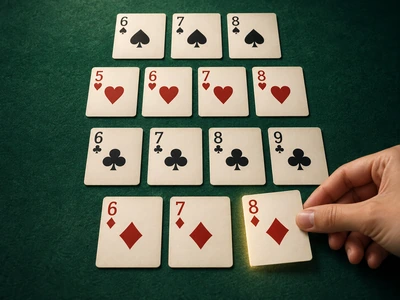
Fan Tan
Fan Tan, also called Sevens, is a four-player race to empty your hand.
Big Two
Big Two (also called Deuces, Pusoy Dos or Capsa) is a four-player race to empty a 13-card hand.
Crazy Eights
Crazy Eights is a four-player race to empty your hand. Each player gets 5 cards.
Dou Dizhu
Dou Dizhu is a three-player card game using a full 54-card deck.
Two-Player Dou Dizhu
Two-Player Dou Dizhu is the head-to-head version of Fight the Landlord.
Laizi Dou Dizhu
Laizi Dou Dizhu is three-player Dou Dizhu with a wild rank.
Gan Deng Yan
Gan Deng Yan is a four-player race to empty your hand with a 54-card deck.
Guandan
Guandan is a Chinese partnership climbing game: four players, two decks plus four jokers, 27 cards…