Loading…
Rotate for the best fullscreen experience
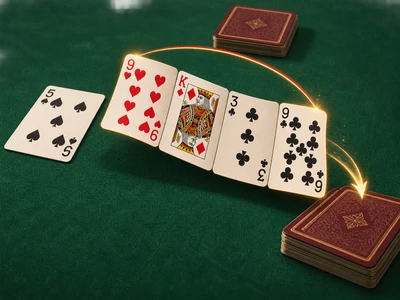
Go Fish is a classic four-player family card game of asking for ranks and collecting books of four. On your turn, ask one opponent for a rank you already hold. If they have any, they must hand over every card of that rank and you ask again; if not, they say Go fish and you draw from the stock. When all 13 books are laid down, the player with the most books wins.
At a glance
| Players | 4 |
|---|---|
| Decks | 1 |
| Jokers | No |
| Difficulty | Easy |
| Computer opponents | Yes |
How to play
Cards, seats and goal
Go Fish uses one standard 52-card deck with no Jokers. This site always plays with four players. You sit at the bottom of the table, and the computer plays the other three seats: Left, Across and Right.
Your goal is to collect books. A book is all four cards of one rank, for example four 7s, whatever their suits. As soon as a player holds all four, the book is laid down and counts for that player. The 52 cards make exactly 13 books, and the player with the most books wins.
The deal
The shuffled deck is dealt starting with you, 5 cards to each player. The remaining 32 cards are placed face down in the middle of the table as the stock. If anyone is dealt all four cards of a rank, that book is laid down straight away.
Your turn: asking for a rank
You play first, and turns then go round in the order You → Left → Across → Right. Every question needs two choices:
- A rank: it must be a rank you already hold at least one card of. If you have no Queens, you cannot ask for Queens.
- An opponent: any other player who still has cards in hand.
There are two possible answers:
- They have it: the opponent must give you every card of that rank, not just one. You then ask again, either the same opponent or a different one.
- They don't: the opponent tells you to "Go fish", and you draw the top card of the stock.
What happens when you go fishing
- If the card you draw is the rank you just asked for, you show it to everyone and ask again.
- If it is any other rank, only you see it, and the turn passes to the next player. Even if that card completes four of a kind, you simply lay down the book; it does not earn you another question.
- If the stock is empty, nothing is drawn and the turn passes to the next player.
For example, suppose you hold 7♣ and 7♦ and ask Across for 7s. Across has 7♥ and hands it over, so you now hold three 7s and ask again. You ask Left for 7s, Left gives you 7♠, and you lay down a book of 7s and keep going. Next you ask Right for Kings, but Right has none, so you go fish. Draw a King and you show it and ask again; draw a 4 and it goes into your hand and it is Left's turn.
Running out of cards
If it is a player's turn and they have no cards in hand, they automatically draw one card from the stock and then ask as usual. If the stock is empty too, that player is out and is skipped from then on. Books they have already laid down still count.
If no other player has any cards left when your turn comes, there is nobody to ask: you draw one card and the turn passes on.
Winning and losing
The game ends when all 13 books have been laid down. By then every hand and the stock are empty.
- You have more books than anyone else: you win.
- You tie for the most books: the game is a draw.
- Someone has more books than you: you lose.
If you run out of cards before the end, the computer players finish the game by the same rules. You can also press Show result to settle the rest of the game at once; the result is exactly the same as playing it out move by move.
About this game
A first card game that rewards a good memory
Go Fish, also simply called Fish, is one of the most familiar children's card games in English-speaking countries. The whole rule fits in a sentence — ask for a rank, hand it over if you have it, otherwise go fish — so anyone who can read card ranks can play. Adults find something to think about too, because every question gives away a piece of information: the player who asks always holds that rank. Whoever remembers those questions best collects books fastest.
On this site four players get five cards each. Fishing up the rank you asked for lets you ask again, while any other card ends your turn even if it completes a book. The game always continues until all 13 books are laid down, so it never stops early just because one player runs out of cards.
Go Fish is not the same as Kitten Fishing, where two players turn over cards from their own piles and capture matching ranks from the table, and it is not Old Maid, where you draw a hidden card from another player's hand to make pairs. In Go Fish there are no cards on the table and no blind draws from other hands: you always name a rank and ask for it.
Playing on this site
Open the page and play right away — no download and no sign-up. A whole game works in portrait and landscape on phones and in desktop browsers.
- Pick a rank: your hand is grouped by rank along the bottom of the table. Tap a group to select that rank, and tap it again to clear it.
- Pick an opponent: tap the seat of Left, Across or Right to choose who to ask. If you only hold one rank, or only one opponent still has cards, it is selected for you.
- Ask: once both are chosen, press Ask. Your first game shows the hint "Pick a rank you hold, then a player to ask", and pressing Ask with only one choice made reminds you to "Pick a rank and a player first".
- Keyboard: use Tab to move between your hand, the opponents' seats and the buttons, the arrow keys to move between rank groups or seats, Enter or Space to select, and Esc to clear the selected rank and opponent.
- Follow every move: the status line spells out each question and answer, such as "You ask Across: any 7s?", "Across gave you 1 × 7 · Ask again", "Right has no K — Go fish!" and "You fished a K — go again!". Each opponent's seat always shows their card count, their books, and their last question — who they asked, for which rank and what happened. The number of cards left in the stock is always on show.
- The book shelf: the middle of the table has a slot for each of the 13 ranks, so you can see at a glance who has made which book.
- Opponents' turns: the computer pauses briefly before asking. When you are the one being asked, the cards taken from your hand are clearly shown leaving it. Tapping your cards during their turn only shows "Not your turn — wait for opponents" and changes nothing.
- Speed up animations: the deal can be skipped with Skip. While cards are being handed over, drawn or laid down as a book, a tap only finishes the animation at once — it never sends an extra question.
- Difficulty: the menu offers Easy, Normal and Hard, with Normal as the default. A new difficulty applies from the next game.
- End and restart: the result panel shows whether you won, drew or lost and every player's books. Press Play again to start straight away. Starting a New game from the menu in the middle of a game asks you to confirm once.
- Autosave: refresh the page, rotate your phone or enter and leave fullscreen, and the game continues where it left off.
There is no undo and no hint. The cards an opponent hands over and the card you fish up both reveal hidden information, so taking back a question would mean choosing again after seeing the answer.
The three computer levels
The levels differ only in how much of the question history the computer remembers. Easy remembers just the last two questions and often asks at random; Normal remembers the last eight; Hard remembers every question in the game. The computer never looks at your hand or the order of the stock, so it knows exactly as much as you do.
Tips for winning
Remember who asked for what. If an opponent asked for 9s, they hold at least one 9. If you have a 9 too, ask them for it on your turn and you may collect several cards at once.
Ask for ranks you hold several of. With three cards of a rank you are one card away from a book, so that is the best rank to ask for first.
Pay attention to "Go fish" answers. If a player has just said they have no 5s, asking them again soon is usually wasted — but once they have drawn or received cards, that may have changed.
Don't give away too much. Every question tells the table you hold that rank. If you only have one card of a rank and are in no hurry, ask for a rank you are surer about first.
A game takes about three minutes. A four-player game usually involves around sixty questions, a dozen or more of them yours, so it is easy to play several in a row.
Go Fish · FAQ
How do you play Go Fish?
Take turns asking one opponent for a rank you already hold. If they have any, they give you all of them and you ask again; if not, you go fish and draw one card from the stock. Four cards of a rank make a book, and when all 13 books are laid down the player with the most books wins.
How many cards do you deal in Go Fish?
On this site four players get 5 cards each and the other 32 cards form the stock. No Jokers are used, so the 52 cards make exactly 13 books.
Can you ask for a rank you don't have in Go Fish?
No. You may only ask for a rank you hold at least one card of, which is why every question tells the other players something about your hand.
Do you have to give all your cards of a rank in Go Fish?
Yes. When you are asked for a rank you hold, you must hand over every card of that rank, not just one.
Do you get another turn if you fish the card you asked for in Go Fish?
Yes. If the card you draw is the rank you asked for, you show it and ask again. Any other card ends your turn, even if it completes a book — you lay the book down but do not get another question.
What is a book in Go Fish?
A book is all four cards of one rank, such as four Jacks, in any suits. It is laid down as soon as you have it, counts for you, and can no longer be asked for.
What happens when you run out of cards in Go Fish?
When it is your turn and your hand is empty, you draw one card from the stock and then ask as usual. If the stock is empty too, you are out. The computer finishes the game, or you can press Show result to see the outcome at once; your books still count.
When does Go Fish end, and can it be a draw?
The game ends when all 13 books have been laid down. You win with more books than anyone else, a tie for the most books is a draw, and anyone else having more books means you lose.
What is the best strategy for Go Fish?
Keep track of who asked for which ranks: anyone who asks for a rank must hold it. On your turn, ask that player for a rank you share. Asking first for ranks you already hold two or three of also completes books faster.
Is Fish the same game as Go Fish?
Yes. Fish is simply another name for Go Fish: ask for ranks, go fish when the answer is no, and collect books of four.
How hard are the computer players in Go Fish?
There are three levels. Easy remembers only the last two questions, Normal the last eight and Hard the whole game. The computer never sees your hand, and a change of level applies from the next game.