
Loading…
Rotate for the best fullscreen experience
Forty Thieves is a two-deck, one-player solitaire. 40 face-up cards form 10 columns of 4; the other 64 form a stock turned one card at a time, once only. Columns build down in suit, one card at a time (runs may move together when enough columns are empty), and an empty column takes any card. Win by moving all 104 cards to eight foundations, Ace to King by suit.
At a glance
| Players | 1 |
|---|---|
| Decks | 2 |
| Jokers | No |
| Difficulty | Hard |
| Computer opponents | No |
How to play
Cards and the opening layout
Forty Thieves uses two standard 52-card decks shuffled together: 104 cards, no jokers. Ranks run from Ace (low) through 2 to 10, Jack, Queen and King, in the four suits of spades, hearts, clubs and diamonds, and every card appears twice. Only the suit matters in this game; red and black play no part.
At the start, 40 cards are dealt face up, row by row, into 10 columns of 4 cards. There are no face-down cards on the table, so you can see every card in the columns from the very first move.
The other 64 cards form the stock, face down. The stock spot shows a card back and how many cards are left; you cannot see what they are until you turn them. Next to it is the waste pile, where turned cards land. Only the top card of the waste can be played.
Above the columns are eight foundations, empty at the start. Each suit gets two of them, because two decks hold two full Ace-to-King sets of every suit.
The goal: fill all eight foundations
A foundation starts with an Ace and then builds up in the same suit, one rank at a time: the 2 of spades goes on the Ace of spades, then the 3, and so on up to the King. When all eight foundations run from Ace to King, all 104 cards are home and you have won.
Cards on a foundation never come back to the columns. Before you send a card up, it is worth asking whether you still need it in the columns as a place for a lower card of its suit.
The columns: down in suit, one card at a time
Cards in the columns build down in the same suit: the 8 of hearts can only go on the 9 of hearts, the Jack of clubs only on the Queen of clubs. A card of another suit will not fit, even if its rank is exactly one lower. Ranks do not wrap around, so nothing can be placed on an Ace in the columns.
By the rules you move one card at a time: the last card of a column, or the top card of the waste. It can go:
- onto a foundation (an empty foundation takes only an Ace; otherwise the next card up in the same suit);
- onto the last card of another column (same suit, exactly one rank lower);
- into an empty column. An empty column takes any card, not just a King.
You cannot pull a card out of the middle of a column, and you cannot take a card back down from a foundation.
Moving runs: a shortcut when columns are empty
Forty Thieves is played one card at a time. But if the end of a column holds a run of cards in the same suit and in order — say the 9, 8 and 7 of spades — and there are empty columns, you could shuttle that run across one card at a time using the empty columns. This site turns that into a shortcut: when there are enough empty columns, the whole run moves at once. The result is exactly the same as moving the cards one by one, it counts as a single move, and one Undo takes the whole run back.
How many cards can move together depends on how many empty columns there are, not counting the destination:
- no empty columns: 1 card;
- 1 empty column: up to 2 cards;
- 2 empty columns: up to 4 cards;
- 3 empty columns: up to 8 cards, and so on — each extra empty column doubles the limit.
If the destination is itself an empty column, it does not count as a helper. When a run is too long for the empty columns you have, nothing moves and the message tells you how many more empty columns you need. The status bar always shows the current number of empty columns and the largest run you can move, so you can plan ahead.
Moving a whole column into another empty column only swaps their places and achieves nothing, so it is not a legal move.
The stock: one card at a time, one pass only
Tap the stock to turn its top card onto the waste pile; that counts as one move. Only the top card of the waste can be played — onto a foundation, onto a column, or into an empty column. The cards beneath it come into play only as the cards above them are used.
The stock goes through only once — there is no redeal. When all 64 cards have been turned, the stock spot is marked as used up, and tapping it again just tells you so. This is what makes Forty Thieves hard: a card buried in the waste that never gets used is gone for good.
Winning, and when nothing moves
To win, move all 104 cards to the eight foundations. A short win animation follows the last card; press Esc or tap the table to skip it. The result panel then shows your time, your moves, the foundation count and the deal number, which you can copy with a tap, and offers New deal and Restart deal.
If the stock is used up and no legal move is left anywhere, the game is over. The panel reads "No moves left" and shows the same details. It offers "Undo last move" so you can step back and try another line, as well as Restart deal and New deal. While the stock still has cards you can always turn one, so this panel never appears before the stock is used up.
Auto-finish
Near the end, once the stock and the waste are both empty and the remaining cards can all go up simply by playing column ends to the foundations in turn, an Auto-finish button appears in the control bar. Tap it and the cards fly up one by one until you win. Each step is an ordinary move to a foundation, so Undo still takes back one card at a time, and you can skip the animation with Esc or a tap on the table. If some column still has a lower card of the same suit buried under a higher one, the button does not appear and you play on yourself.
Three ways to move
A single press only ever triggers one of these:
- Tap. Tap a column's last card, the top waste card, or the first card of a same-suit run, and it moves straight away. A single card goes to a foundation if it can; otherwise onto a column it fits, choosing the leftmost; otherwise into the leftmost empty column. When you tap a run of two or more cards, foundations are skipped. If there is nowhere to go, nothing moves and you are told why.
- Drag. Press and drag a card and it follows your finger, together with any cards that can move with it. Release it on a legal spot to move it; release anywhere else and it slides back. Use a drag when you want the other foundation of a suit, a different column or a particular empty column.
- Long press a column or the waste. Long press (or right-click on a computer, or press Enter or Space on it with the keyboard) to open the run and destination picker. It shows every card of that column at a large size. Choose which card to start from — runs that are too long for your empty columns are marked with how many more you need — then pick one of all the legal destinations and press Move. Long lists are split into pages. Cancel, Esc or a tap outside the picker leave the game unchanged.
Tapping the stock turns a card.
Every illegal move slides back with a short reason: needs the same suit, needs a card one rank lower, an empty foundation takes only an Ace, nothing goes on an Ace in the columns, not enough empty columns for that run, cards on foundations stay there, or the stock is used up. The position does not change, so a mis-tap costs you nothing.
Long columns
Because same-suit building stops at the Ace, a column can never be longer than 16 cards: up to 3 cards left from the deal plus one full King-to-Ace run. As a column grows, its cards close up, but every rank and suit corner stays readable. If the screen still cannot fit it, the column switches to a dense view marked "Dense": the last card and the first card of its run stay fully visible and the cards in between collapse into a stack with a count. Long press that column and the picker lists the whole column card by card, so nothing is ever lost.
Undo and hints
Undo is unlimited, including turning a card, moving a run and every step of Auto-finish. Undoing a turn puts the card back on top of the stock, face down again, but the game remembers that you have seen it.
The hint button marks a move worth making. It looks first for cards that can go to a foundation (Aces and 2s first), then for a move that plays the top waste card onto a column, then for a move that empties a column, then for column moves that lead to one of those within a few steps. Only when none of those exist does it suggest turning a card from the stock. While the stock still holds cards you have not seen, hints only use what is visible and never claim the deal cannot be won; the game does not peek at the stock.
Once the stock is used up, if no move makes progress — nothing goes to a foundation, nothing leaves the waste and no column empties — the hint says "No move now makes progress" and suggests Undo or a new deal. That is not a loss. When every card has been seen, the hint can also check the deal: if it confirms that this deal can no longer be finished from here, it says so and offers Restart deal and New deal. Even then it is only a hint and never ends the game for you. While it works, the hint bar shows "Checking…" and the table stays responsive.
Status bar and keyboard
The status bar always shows your moves, your time, foundation progress (N/104), the cards left in the stock, and the number of empty columns with the largest run you can move. Four controls sit under the table at all times — Undo, Hint, New and Rules (a jump to this how-to section) — and Auto-finish joins them when it is available.
With a keyboard, Tab moves focus onto the table and the arrow keys move between the stock, the waste, the eight foundations and the ten columns. Enter or Space on a column or the waste opens the picker; inside it, Tab moves between run lengths, destinations and the Move button, and Esc cancels. Enter or Space on the stock turns a card. Shortcuts: U undoes, H gives a hint, N deals a new game, D turns a card, and A starts Auto-finish when it is available.
A one-line tip appears on your first visit and disappears when you tap "Got it" or make any move. The clock stops when you switch tabs and resumes when you come back; rotating the phone, resizing the window and entering or leaving full screen all keep the current deal exactly as it was.
About this game
What is Forty Thieves?
Forty Thieves, also called Forty Thieves Solitaire, is a classic two-deck patience for one player. It is also widely known as Napoleon at St Helena, and some books list it as Le Cadran or Big Forty — though Big Forty is sometimes used for an easier variant, so check the rules when you see that name elsewhere. The "forty" in the name is the 40 cards laid out face up at the start.
It is the best-known of the two-deck solitaires and the head of a large family of related games. This site plays the standard version: two decks, 104 cards; 10 columns of 4, all face up; a 64-card stock turned one card at a time with no redeal; columns build down in suit, one card at a time, with runs moving together only when enough columns are empty; any card in an empty column; eight foundations built up in suit from Ace to King; and no taking cards back from the foundations.
How it differs from other solitaire games
Compared with FreeCell, both games deal everything face up and rely on spare space to move runs. But FreeCell uses one deck, gives you four free cells and has no stock. Forty Thieves has no free cells at all — empty columns are your only spare space — and adds a stock you get to go through just once.
Compared with Spider, both use two decks and ten columns. But Spider's stock deals a card onto every column at once, and a run only leaves the table when it is a complete King-to-Ace sequence. In Forty Thieves the stock feeds a waste pile and cards go up to the foundations one at a time.
The Forty Thieves family includes many close relatives: some allow redeals, some start with the Aces already on the foundations, some let you move runs of any length, some build in alternating colours, and one uses three decks. This page describes, and this site offers, the standard Forty Thieves only.
Why it keeps you playing
A deal takes about ten to twenty minutes. Forty Thieves is famous for being hard: many deals cannot be won, and success takes planning as well as some luck. With all 40 cards visible from the start, you can plan from the first move — but the 64-card stock passes only once, and every card you turn is either used right away or buried deeper in the waste.
The real key is empty columns. With no free cells, an empty column is the only place to park a card, and it also decides how long a run you can move. Clearing one column often opens up the whole game; filling it carelessly may mean you never clear another. Unlimited undo and Restart deal let you try the same cards again with a different plan.
Strategy tips
These are tips from experience, not rules:
- Read all ten columns before you start. Everything is face up, so find the Aces and 2s and see what is sitting on them.
- Get Aces and 2s up early. They are almost useless in the columns, and sending them up frees space.
- Do not rush high cards to the foundations. They can never come back, and you may need them as a landing spot for a lower card of their suit.
- Make empty columns a priority. A move that clears a column is usually the most valuable one on the table, and every extra empty column doubles the run you can move.
- Do not fill an empty column without a reason. Put a card there only if it frees something right away, or if it is a high card you can build a long run on.
- Exhaust the columns before turning a card. The stock goes through once, so make sure each card you turn has a chance of being used. The deeper the waste, the harder it is to reach what is underneath.
- Keep both foundations of a suit moving. Each suit has two foundations; building them up in turn gives you more options than racing one ahead.
- Ask for a hint when you are only shuffling. If you find yourself moving cards back and forth between two columns, a hint will show whether any real progress is left — or undo a few moves and try another line.
Forty Thieves · FAQ
What are the rules of Forty Thieves solitaire?
Two decks (104 cards) are used. 40 cards are dealt face up into 10 columns of 4, and the other 64 form the stock. Columns build down in the same suit, one card at a time, with runs moving together as a shortcut when enough columns are empty; an empty column takes any card. The stock is turned one card at a time onto a waste pile and goes through only once. Move all 104 cards to the eight foundations, Ace to King by suit, to win.
Can you only move one card at a time in Forty Thieves?
Yes, by the rules. But when there are empty columns, a same-suit run in order can move at once, exactly as if you had shuttled it card by card: with one empty column besides the destination you can move 2 cards, with two you can move 4, and each extra empty column doubles the limit.
How many times can you go through the stock in Forty Thieves?
Only once. Each tap turns one card onto the waste, and only the top waste card can be played. When all 64 cards have been turned there is no redeal, and the stock is marked as used up.
What can go into an empty column in Forty Thieves?
Any card, not just a King — and, with enough empty columns, a same-suit run. Moving an entire column into another empty column changes nothing, so it is not allowed.
Can you move cards back from the foundations in Forty Thieves?
No. Once a card is on a foundation it stays there, so before sending up a high card, think about whether a lower card of its suit still needs it as a landing spot.
Why does Forty Thieves have eight foundations?
Because it is played with two decks, there are two Ace-to-King sets of every suit. Each of the eight foundations starts with an Ace and builds up in suit to the King. The two foundations of a suit work the same way: a tap sends a card to the first one, and a drag or the picker lets you choose the other.
Can every deal of Forty Thieves be won?
No. Forty Thieves is known as a hard game, and many deals cannot be won. While the stock still holds cards you have not seen, hints only give advice and never say a deal is lost. Once every card has been seen, a hint may tell you the deal can no longer be finished from here and offer Restart deal and New deal.
Does "No move now makes progress" mean I lost at Forty Thieves?
No. It means the stock is used up and no move right now sends a card to a foundation, uses a waste card or empties a column — only moves that shift cards around. You can undo a few moves and try another line, or start a new deal; the game does not count it as a loss.
When does Auto-finish appear in Forty Thieves?
When the stock and the waste are both empty and every remaining card can go up just by playing column ends to the foundations in order. Tap the button and the cards go up one by one; every step can be undone and the animation can be skipped.
How do I play Forty Thieves on a phone when the cards are crowded?
Long press the column or the waste. The picker opens with every card of the column shown large: choose where the run starts, pick a destination from the list and press Move. Every button is large enough to hit, cancelling changes nothing, and Undo is always there.
How do I play Forty Thieves with a keyboard?
Tab moves focus onto the table, and the arrow keys move between the stock, the waste, the foundations and the columns. Enter or Space on a column opens the picker; inside it, Tab reaches the run lengths, destinations and the Move button, and Esc cancels. Enter on the stock turns a card. U undoes, H gives a hint, N deals a new game, D turns a card and A starts Auto-finish.
Related games
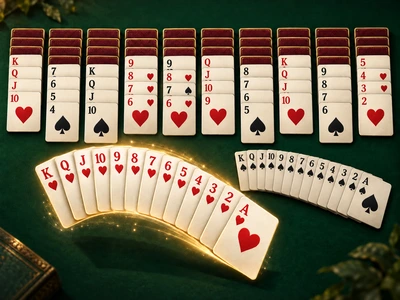
Spider Solitaire (2 Suits)
Spider Solitaire (2 Suits) is a one-player card game played with 104 cards in just spades and…
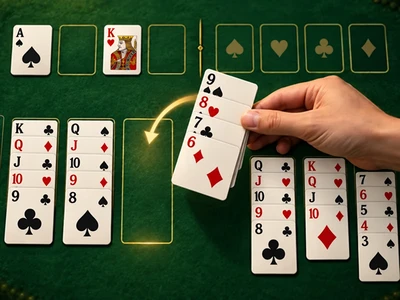
FreeCell Solitaire
FreeCell Solitaire is a one-player card game played with a single 52-card deck, dealt face up into…
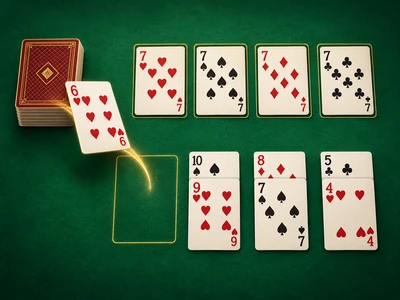
Canfield Solitaire
Canfield Solitaire is a one-deck game for one player.
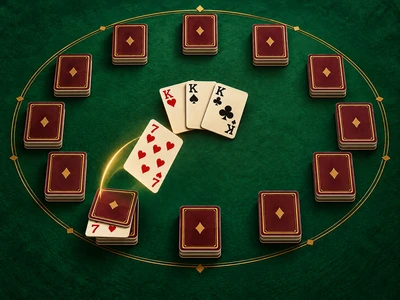
Clock Solitaire
Clock Solitaire is a one-deck patience: 13 face-down piles of 4, twelve round a clock face and the…
Double Klondike Solitaire
Double Klondike, also known by its classic name Gargantua, is a one-player solitaire played with…
Golf Solitaire
Golf Solitaire is a one-player card game with one 52-card deck.
Klondike Solitaire Daily Challenge
Klondike Solitaire Daily Challenge gives you one classic Turn 1 Klondike deal per day, and…
Klondike Solitaire (Turn 1)
Klondike (Turn 1) is the classic single-player solitaire played with one 52-card deck.