
Loading…
Rotate for the best fullscreen experience
Double Klondike, also known by its classic name Gargantua, is a one-player solitaire played with two decks, 104 cards in all. 45 cards are dealt into 9 columns and the other 59 form a stock you turn one card at a time, with a single recycle. Columns build down in alternating colours, and you win by moving all 104 cards to eight foundations, Ace to King by suit.
At a glance
| Players | 1 |
|---|---|
| Decks | 2 |
| Jokers | No |
| Difficulty | Medium |
| Computer opponents | No |
How to play
Cards and the opening layout
Double Klondike uses two standard 52-card decks shuffled together: 104 cards, no jokers. Every card appears twice, so there are two 7s of spades, two Queens of hearts and so on. Ranks run from Ace (low) through 2 to 10, Jack, Queen and King (high). Spades and clubs are black; hearts and diamonds are red.
At the start, 9 columns are dealt from left to right: 1 card in the first column, 2 in the second, and so on up to 9 in the ninth, 45 cards in all. Only the last card of each column is face up; the cards above it are face down, and the long ninth column hides 8 of them. The other 59 cards sit face down in the top-left corner as the stock. Next to it is the waste pile, empty at the start.
Along the top of the table are eight foundations, two for each suit. Two decks hold two complete Ace-to-King sets of every suit, so each suit needs two foundations to collect them.
Drawing cards and the single recycle
Each tap on the stock turns one card onto the waste pile, on top of what is already there. Only the top card of the waste can be played. Once you play it, the card underneath becomes the playable one.
When the stock runs out, tap the empty stock spot to turn the whole waste pile back over, in its original order, as a new stock. This is a recycle, and in Double Klondike you get only one, so you can go through the stock exactly twice. The empty stock spot shows how many recycles are left; once the recycle is used, it is marked Spent. Tapping a spent stock is not a legal move: the game shows that it was refused and nothing on the table changes. The status bar also shows how many recycles you have used out of the limit.
The limited recycle is the biggest difference from ordinary Klondike. Every card you turn uses up part of a scarce resource, and a card you could not use on the first pass gets exactly one more chance on the second.
Building in the columns
Cards in the columns build down in alternating colours, one rank at a time. A red 7 can go on a black 8; a black 9 can go on a red 10. Only colour and rank matter, not the exact suit, and the two copies of a card can be used in different places.
You can move a single face-up card, or start from any face-up card and move it together with everything below it, as long as that run is already in order. Whether the move is allowed depends only on the top card of the run: it must be one rank lower than the card it lands on and the opposite colour. If a move leaves a face-down card at the end of a column, that card turns face up automatically. An empty column takes only a King, or a run that starts with a King.
To start a move from the middle of a run, press and hold the column. A small panel opens showing which card the run starts from. Keep your finger down and slide onto the panel's up and down arrows to change the starting card; lifting your finger confirms. Confirming only selects that run; it does not move anything by itself. Tap a destination, or drag the run there, to complete the move. With a keyboard, the up and down arrow keys change the starting card, Enter confirms, and Esc closes the panel without changing the game.
Building on the foundations
Each foundation holds a single suit and builds up in the same suit, one rank at a time, from Ace to King. A foundation can only be started with an Ace; after that it takes the next card of the same suit. The two foundations of a suit are completely independent: one can be up to the 9 while the other has just received its Ace.
When a card fits on both foundations of its suit, both are legal targets and you can drag it to either one. If you tap the card to send it automatically, it goes to the left-hand one. Cards can come from the top of the waste or from the last face-up card of any column.
The top card of a foundation can also be moved back down to a column, as long as it follows the column rule: one rank lower and the opposite colour. Sometimes you need to bring a card back down to give another card somewhere to land.
Winning, and when the game ends
When all eight foundations run from Ace to King and all 104 cards are home, you win. There is no time limit and no scoring, and you can undo as often as you like. Undoing a recycle gives the recycle back.
Going through the stock twice does not end the game. After the recycle is spent and the stock is empty, the top card of the waste can still be played, cards can still move between columns, and foundation cards can still come back down. As long as there is any legal move at all, you keep playing. Only when the whole position has no legal move left does the game end the deal on its own. It tells you there are no moves left, and the results panel shows your time, moves, recycles, the number of cards home and the deal ID, with four ways out: a new deal, replay this deal, view the board, or undo the last move.
There is also the case where you still have moves but they only go round in circles. The game never declares that a loss for you. Tap Hint and a dismissible bar appears with Undo, Hint, Replay this deal and Different deal, so you decide what to do next.
Controls on this page
Tap a card to select it, then tap where it should go, or simply drag it. When a card has only one legal destination, a single tap sends it there. A drop that does not fit snaps back with a short message. Undo is always available, Hint points out a useful move and previews it on the table, and New deal starts a fresh shuffle straight away. To play the same cards again, use Replay this deal on the results panel or the hint bar. The first time you play, a short tip by the stock reminds you to tap it to draw and that you get one recycle only; it disappears as soon as you do anything.
Once all face-down cards in the 9 columns are turned up, the stock is either empty or has already been recycled once (so it holds no card you have not seen), and the remaining cards can all go home under the rules, the third button on the toolbar becomes Auto finish. It moves the cards to the foundations one by one; tap again to stop, and carry on by hand whenever you like. Keyboard shortcuts: U to undo, H for a hint, N for a new deal, F for auto finish, Space to draw, and the left and right arrow keys move focus between piles.
The deal ID is shown on the results panel, and one tap copies it. To play exactly the same deal again, use Replay this deal on that panel. The Rules button on the table jumps to this how-to section. Rotating your phone, resizing the window or entering and leaving full screen all keep the current game exactly as it was.
About this game
Klondike, doubled
Double Klondike is classic Klondike scaled up: two decks instead of one, 9 columns instead of 7, and eight foundations instead of four. The familiar rules all stay the same: alternating colours in the columns, Kings only in empty columns, and face-down cards turning up as you uncover them. If you already know Klondike, you can start playing straight away.
Its classic name in patience books is Gargantua, while computer solitaire collections usually call it Double Klondike; both names describe the same game. The British games writer David Parlett recorded it in his collection of patience games: two decks, nine columns, one card turned at a time and a stock that can be dealt twice. That is the version on this page, with no other variant mixed in.
One note on the name: Double Klondike is sometimes used for a different, competitive game for two players, also called Double Solitaire. The game here is the one-player version, with no opponent and no race against anyone.
What makes it different from Klondike
Two decks change two things. First, every card has a twin. A red 6 may be buried under face-down cards while the other red 6 sits on top of the waste, ready to use. When a position looks stuck, the second copy of a card is often the way out.
Second, the stock lasts only two passes. Many people play ordinary Klondike going through the stock as often as they like; here there is a single recycle, so turning cards becomes a resource to spend with care. Which cards you take on the first pass, and which you leave for the second, decides whether you still have moves late in the game.
The good news is that nine columns and eight foundations give you far more room to manoeuvre, and columns are easier to clear. If you do not waste the first pass and you plan the second, many deals can be won, but not every deal can be.
How long a game takes
With 104 cards to sort, a game of Double Klondike usually takes around twenty minutes, a little longer than single-deck Klondike. There is no clock pressure and no score, so you can stop and think as long as you like, or switch to another tab and come back to the same position.
Double Klondike strategy tips
- Uncover cards before you draw. The sooner face-down cards turn up, the more choices you have. With only two passes through the stock, make the moves already on the table before you turn another card.
- Work on the long columns. The columns on the right hide the most face-down cards, so freeing them is usually worth the most.
- Remember the first pass. The second pass turns the cards up in the same order. If you noticed a card you could not use the first time, you know when it is coming and can prepare a place for it.
- With twin cards, use the easy one. A copy on top of the waste or at the end of a column is ready now; the buried twin can wait.
- Do not rush every low card home. Aces and 2s can always go up, but 5s and 6s are often more useful on the table as landing spots for lower cards.
- Save empty columns for the right King. When a column empties, put in the King whose move uncovers the most face-down cards. If no King is ready, leaving the column empty costs nothing.
- Try before you commit. You can undo as often as you like, and even a recycle can be undone, so when you are unsure, play a few moves ahead and step back if they lead nowhere.
Double Klondike Solitaire · FAQ
What is the difference between Double Klondike and regular Klondike?
Double Klondike uses two decks of 104 cards, deals 9 columns, has eight foundations and allows only one recycle of the stock. Regular Klondike uses one 52-card deck, 7 columns and four foundations. The building rules and the Kings-only rule for empty columns are the same in both.
How many times can you go through the stock in Double Klondike?
Twice: you get one recycle. After it is used, the empty stock spot shows Spent and tapping it changes nothing. If you undo the recycle, you get it back.
Do you lose in Double Klondike when the stock runs out?
No. After the stock is spent, you can still play the top card of the waste, move cards between columns and bring foundation cards back down. The game only ends the deal on its own when there is no legal move left anywhere.
How do the two foundations per suit work in Double Klondike?
Each one builds from Ace to King on its own. When a card fits both, you can put it on either; tapping to send it automatically uses the left-hand one.
How many cards do you draw at a time in Double Klondike?
One. The card lands on top of the waste pile, and only that top card can be played. Once you play it, the card underneath becomes available.
What can go into an empty column in Double Klondike?
Only a King, or a run that starts with a King. A Queen or any lower card cannot be placed in an empty column.
Can you take cards back off the foundations in Double Klondike?
Yes. The top card of a foundation can move back to a column if it is one rank lower and the opposite colour of the card it lands on. Sometimes that is the move that frees a face-down card.
Can you move several cards at once in Double Klondike?
Yes. Start from any face-up card and move it with the ordered run below it, as long as the top card of the run fits where it lands. To start from the middle of a run, press and hold the column, choose the starting card with the panel's arrows, release to confirm, then tap the destination or drag the run there.
Can every game of Double Klondike be won?
No. Two decks and nine columns give you more room than single-deck Klondike, but the stock lasts only two passes, and when key cards are buried too deep no line of play wins. If a deal will not come out, starting a new one is perfectly normal.
Are Double Klondike and Gargantua the same game?
Yes. The game on this page is Gargantua, which computer solitaire collections usually call Double Klondike. The name Double Klondike is also sometimes used for a two-player competitive game, but that is a different game; this one is played alone.
Can I replay the same Double Klondike deal?
Yes. Replay this deal on the results panel or the hint bar restarts exactly the same cards, and the deal ID on the panel can be copied with one tap.
Related games
Klondike Solitaire (Turn 1)
Klondike (Turn 1) is the classic single-player solitaire played with one 52-card deck.
Klondike Solitaire (Turn 3)
Klondike Solitaire (Turn 3) is the draw-three version of the classic one-player card game, played…
Canfield Solitaire
Canfield Solitaire is a one-deck game for one player.
Clock Solitaire
Clock Solitaire is a one-deck patience: 13 face-down piles of 4, twelve round a clock face and the…
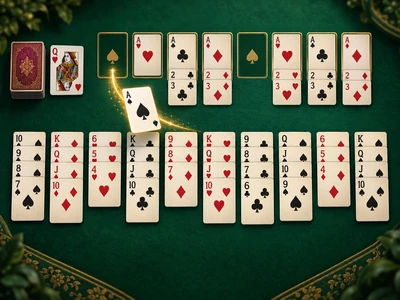
Forty Thieves
Forty Thieves is a two-deck, one-player solitaire.
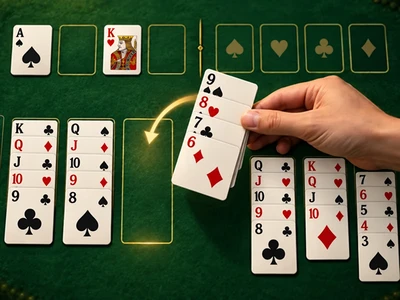
FreeCell Solitaire
FreeCell Solitaire is a one-player card game played with a single 52-card deck, dealt face up into…
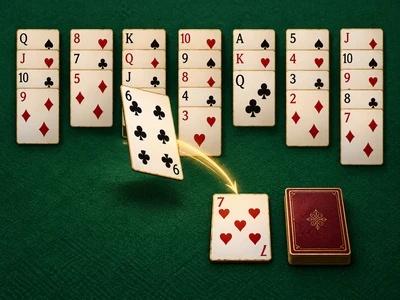
Golf Solitaire
Golf Solitaire is a one-player card game with one 52-card deck.
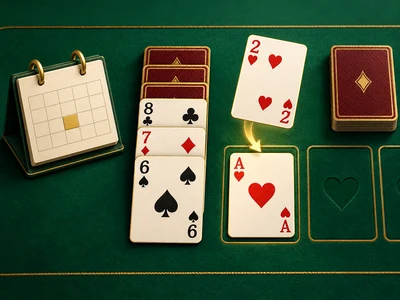
Klondike Solitaire Daily Challenge
Klondike Solitaire Daily Challenge gives you one classic Turn 1 Klondike deal per day, and…