
Loading…
Rotate for the best fullscreen experience
Klondike Solitaire (Turn 3) is the draw-three version of the classic one-player card game, played with a single 52-card deck. Seven columns are dealt, 24 cards stay in the stock, and every draw turns three cards of which only the top one is playable. Recycling the stock is unlimited. Build each foundation up from ace to king and win with all 52 cards home.
At a glance
| Players | 1 |
|---|---|
| Decks | 1 |
| Jokers | No |
| Difficulty | Hard |
| Computer opponents | No |
How to play
Deck and layout
Klondike uses one standard deck of 52 cards with no jokers. Aces are low and kings are high, so every suit runs A, 2, 3 … 10, J, Q, K. Spades and clubs are black, hearts and diamonds are red.
The deal builds seven columns from left to right: one card in the first column, two in the second, and so on up to seven in the last, 28 cards in all. Only the bottom card of each column starts face up; the cards above it are face down. The remaining 24 cards go face down into the stock in the top-left corner. Beside it sits the waste, which starts empty, and on the other side are four empty foundations, one per suit.
Drawing three at a time
This page is the Turn 3 version. Each tap on the stock turns three cards at once onto the waste, with the last one landing on top. The three cards are fanned out sideways so you can read every rank and suit, but only the top card is playable. Play it and the card underneath becomes available; play all three and you must draw again.
When fewer than three cards are left in the stock, the draw simply turns whatever remains, and the fan shrinks to match. Once the stock is empty, tap the empty stock space and the whole waste is turned back over in the same order to become a new stock. There is no limit on how many times you may recycle, and the status bar counts each pass. Tapping the stock when both the stock and the waste are empty is not a legal move, so the game answers with feedback instead of changing the board.
The idea that makes draw three interesting is phase. Cards always leave the stock in groups of three, so the two cards buried under the top of each group are out of reach on this pass. To get at them you either play the card above them, which exposes the next one, or recycle so that the groups fall differently. Remembering which three cards come up together is the real skill of this version.
Building the columns
Columns are built downward in alternating colours: a red 7 on a black 8, a black 9 on a red 10, and so on. Only colour and rank matter, never the exact suit.
You can move a single face-up card, or a whole run of face-up cards that is already in sequence, onto another column. The rule is checked on the first card of the run: it must be one rank lower than the card it lands on and of the opposite colour. Whenever a move leaves a face-down card at the bottom of a column, that card turns over automatically. An empty column takes only a king, or a run that begins with a king; queens and lower cards cannot start one.
To take a run from the middle rather than from the end of a column, press and hold on that column. A small panel opens and shows which card the run starts from and how many cards go with it. Without lifting your finger, slide onto the up or down arrow to change the starting card, then lift to confirm. Confirming only selects the run; it never moves a card on its own, so you still tap the destination or drag the run there. With a keyboard the up and down arrow keys change the starting card, Enter or a click on the preview card in the panel confirms, and Escape closes the panel without touching the board.
Building the foundations
Each foundation belongs to one suit and is built upward in that suit from ace to king. An ace opens a foundation and after that only the next card of the same suit may be added. Cards can come from the top of the waste or from the bottom card of any column.
The top card of a foundation can also be brought back down onto a column when it fits the column rule, one rank lower and the opposite colour. In a tight position that is sometimes the only way to free a face-down card.
Winning and getting stuck
You win when all four foundations run from ace to king and all 52 cards are home. There is no time limit, no score and no penalty for a long game; the results panel shows your time, your number of moves, how many times you recycled, how many cards are home and the deal ID.
If no legal move is left anywhere, the game says so at once and offers four ways out: a new deal, a replay of this deal, a look at the final board, or an undo of the last move. If moves remain but none of them makes real progress, pressing Hint brings up a short dismissible note with the same kind of exits. Undo is always available, so you never have to reload the page to carry on.
Controls on this page
Tap a card to select it and tap its destination, or simply drag it. When a card has exactly one legal destination, a single tap sends it there, and an illegal drop springs back with a short message. Undo has no limit, Hint points out a useful move and previews it on the table, and New deal starts a fresh set of cards straight away; to play the same cards again, use Replay deal on the hint note or Replay this deal on the results panel.
Once every column card is face up and the stock holds nothing you have not already seen — that is, the stock is empty or you have recycled at least once — the third button becomes Auto finish and sends the remaining cards home one by one; tap it again to stop and keep playing by hand. On a keyboard, U undoes, H asks for a hint, N starts a new deal, F runs auto finish, the space bar draws from the stock and the left and right arrow keys move the focus between piles.
Every deal has an ID, shown on the results panel and copied with one tap, and Replay this deal deals exactly the same cards again. A Rules link on the table jumps to this how-to section. Rotating the device, resizing the window or going full screen keeps the game you are playing; nothing is restarted.
About this game
A classic of patience games
Klondike is the best known of all one-player card games, the family usually called Solitaire in North America and Patience in Britain. The name is generally linked to the Klondike Gold Rush in the Canadian Yukon at the end of the nineteenth century, and card game books from the early twentieth century already describe the familiar shape of seven columns, a stock and four foundations. Bundling the game with personal computers turned it into one of the most played card games in history, and the rules have barely changed since.
Why Turn 3 is harder
Klondike is dealt in two main ways. Drawing one card at a time makes every card in the stock reachable on each pass. Turn 3 hands you three cards but only the top one, so the other two wait for the next pass or for a recycle. You have to decide in advance which card of a group you want and what will be exposed when you take it, which is why draw three is won noticeably less often than draw one.
What keeps it fair is the unlimited recycling. The stock can be read again and again, so as long as some move on the table changes the phase, a buried card is never gone for good. That mix of pressure and patience is why many long-time players treat Turn 3 as the real Klondike.
Why one more deal is tempting
A game runs about ten to fifteen minutes and every move is a small decision: which column to free first, when to send a card to the foundation and when to keep it on the table as a landing spot, whether an extra pass through the stock is worth it. Not every deal can be won, but careful play wins far more often than hasty play, and that gap is what pulls you into the next deal.
Strategy tips for draw three
- Plan before you draw. Every draw changes the phase, so check the moves already available on the table first.
- Remember the groups. After one full pass you have seen the buried cards, so you know when to stop tapping on the next pass.
- Uncover face-down cards first. When two moves look equal, take the one that turns a hidden card, especially in the long columns on the right.
- Do not rush low cards home. Aces and twos can always go up, but a 5 or 6 may still be needed as a parking place for a 4.
- Choose the right king. When a column empties, put in the king whose move frees the most hidden cards; with no king ready, an empty column can wait.
- Treat a recycle as a resource, not an ending. Passes are unlimited, but each one should change something on the table, or the next ten will look exactly the same.
Klondike Solitaire (Turn 3) · FAQ
What is the difference between Klondike Turn 3 and Turn 1?
Turn 3 turns three cards from the stock at once and only the top one can be played, while Turn 1 turns a single card that is always playable. In Turn 3 the two buried cards wait for the next pass or a recycle, which makes the game clearly harder.
Can I play all three cards that Klondike turns over?
Not straight away. Only the top card of the fan is playable; once it goes to a column or a foundation, the card beneath it becomes available, and then the third one.
How many times can I recycle the stock in Turn 3 Solitaire?
As often as you like. When the stock is empty, tap it and the waste is turned back over in the same order to form a new stock. The game counts every pass for you.
What happens in Klondike when fewer than three cards are left in the stock?
The draw turns over however many cards remain, one or two, and the fan on the waste shrinks accordingly. Nothing is skipped and nothing is padded.
What can go into an empty column in Klondike?
Only a king, or a run of cards that starts with a king. Queens and lower cards cannot be moved into an empty column.
Can I move a card back from a foundation in Solitaire?
Yes. The top card of any foundation can return to a column if it follows the column rule, one rank lower and the opposite colour. It is sometimes the only way to reach a face-down card.
Is every Klondike Turn 3 deal winnable?
No. Some deals cannot be solved however well you play, because key cards are buried in an impossible order. Draw three is won less often than draw one, so starting a different deal is a normal part of the game.
How do I move a run from the middle of a column in Klondike?
Press and hold on the column to open the small panel that picks the starting card, choose it with the arrows and lift your finger to confirm. Confirming selects the run, so you then tap its destination or drag it there. With a keyboard, the up and down arrows change the starting card, Enter confirms and Escape cancels without changing anything.
Does this Klondike game have a time limit or a score?
No. There is no countdown, no penalty and no scoring system. When a deal ends you simply see your time, your moves, your recycles and how many cards are home.
Can I replay the same Klondike deal?
Yes. Both the results panel and the hint note offer Replay this deal, which deals exactly the same cards again, and the deal ID on the panel can be copied with a single tap.
Related games
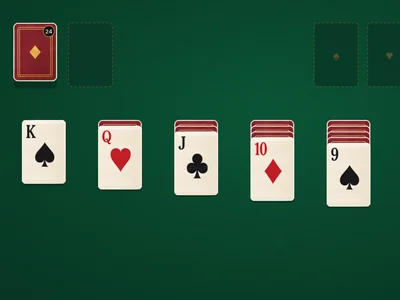
Klondike Solitaire (Turn 1)
Klondike (Turn 1) is the classic single-player solitaire played with one 52-card deck.
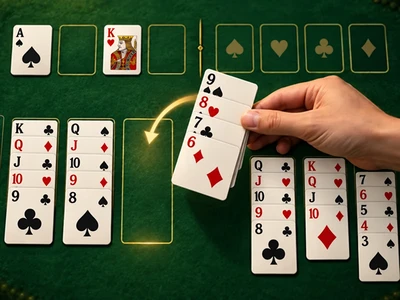
FreeCell Solitaire
FreeCell Solitaire is a one-player card game played with a single 52-card deck, dealt face up into…
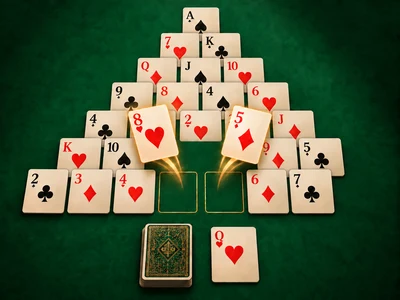
Pyramid Solitaire
Pyramid Solitaire is a one-player game played with a single 52-card deck.
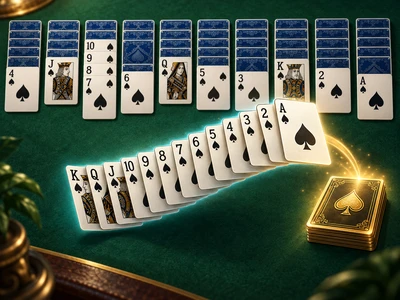
Spider Solitaire (1 Suit)
Spider Solitaire (1 Suit) is a one-player card game played with two 52-card decks in which every…
Spider Solitaire (2 Suits)
Spider Solitaire (2 Suits) is a one-player card game played with 104 cards in just spades and…
Spider Solitaire (4 Suits)
Spider Solitaire (4 Suits) is the full, standard game: 104 cards from two decks, with 26 each of…
TriPeaks Solitaire
TriPeaks Solitaire is a one-player card game played with a single 52-card deck.