
Loading…
Rotate for the best fullscreen experience
Spider Solitaire Daily Challenge gives you one one-suit Spider deal per day, and everyone who plays on the same date gets the same cards. A new deal arrives at local midnight. Build down in ten columns of spades, King-to-Ace runs of 13 cards are taken away, and clearing all 8 sets completes the day. Replay today's deal as often as you like.
At a glance
| Players | 1 |
|---|---|
| Decks | 2 |
| Jokers | No |
| Difficulty | Easy |
| Computer opponents | No |
How to play
One deal a day, the same cards for everyone
Spider Solitaire Daily Challenge — also called Spider Daily or Daily Spider Solitaire — turns one-suit Spider into a fixed puzzle for each day. Open the game and you are playing today's deal, with its date shown in the status area. On the same date the deal is identical on every phone and computer and in every language, so everyone who opens it today is playing exactly the same cards as you.
The day follows the calendar on your own device: once your local time passes midnight, there is a new deal. Players in other time zones switch at a different moment, but the same date always means the same cards. There is no button for a random new deal — each day has only this one. To try again, press Replay deal and start over from the same opening position, as many times as you like.
If midnight passes while you are in the middle of a game, nothing is interrupted. When you come back to the page or make your next move, the date gains a "Past deal" mark and a Start today's challenge button appears in the status area; the new day's cards only arrive when you press it. An unfinished game from an earlier day is restored the next time you open the page, with the same mark and the same button.
The deck, the deal and the table
The deal itself is standard one-suit Spider Solitaire. Two standard 52-card decks are used, 104 cards with no jokers, and every card is a spade, so the deck is eight complete runs of A to K. Ranks count as A=1, 2 to 10 at face value, J=11, Q=12 and K=13.
Fifty-four cards go into ten columns: the first four columns get 6 cards each and the other six get 5 each. Only the last card of each column is face up; everything above it is a face-down card you can count but cannot read yet. A new deal starts with 10 cards visible and 44 face-down cards on the table.
The other 50 cards wait in the deck and come out ten at a time, one per column, over five deals. The status area shows the date of the deal, how many deals are left, how many sets you have cleared out of 8, how many face-down cards remain, your moves and your time. The time is only a record; nothing counts down.
Building down and moving a run
There are only two kinds of move: move cards between columns, or deal a row.
Inside a column you build down by rank, and suit does not matter for stacking: any card may go on a card exactly one rank higher. The top card of a column can always be moved on its own. Several cards move together only as a same-suit run in unbroken descending order — and since all 104 cards are spades, any block that runs down without a gap can travel as one unit, so 9-8-7-6-5 can go onto any 10 in a single move.
An empty column accepts any card or any run you are allowed to move, whatever its rank. When moving cards leaves a face-down card on top of a column, it turns over at once and the face-down counter drops by one.
Dealing a row from the deck
When useful moves run out, tap the deck to deal a row: one new card lands face up on every column. Two conditions apply. You cannot deal a row while any column is empty, so fill every empty column first. And after five deals the deck is empty; the button is greyed out and says there is nothing left to deal. A new row lands on top of whatever you have built and often breaks a tidy sequence, so choosing the moment to deal is the central decision of every game.
Completing a set from King to Ace
When thirteen cards of the same suit from K down to A line up in one column, the set leaves the table on its own and moves to one of the eight foundation places, and the counter shows "Sets N/8". It does not matter whether you built the run by moving cards or the last card arrived with a dealt row; you never have to take a set away yourself. Eight sets use all 104 cards, so clearing them all completes today's challenge.
Controls: tap, drag and the segment picker
- Tap a face-up card and the run starting at that card moves straight to the best target, in a fixed order: a target that completes a set at once, then a card of the same suit one rank higher, then any other legal non-empty column, and only then an empty column, with the lowest-numbered column breaking a tie.
- Drag a card and its run follows; drop it where you want it. An illegal drop springs back and changes nothing.
- Press and hold a column (or right-click it, or focus it with the keyboard and press Enter) to open the segment picker. It enlarges the column so every face-up card can be read, lets you choose with ▲ and ▼ how many cards to take, and lists every legal target, paged when there are many. Confirm to move; cancel or Esc changes nothing.
Long columns on a phone have to overlap tightly. When that happens the column carries a dense mark, its bottom card stays fully readable, and the segment picker shows the rest at full size. Illegal actions never change the position, and each one bounces back with a short line saying why.
Undo, hints and the end of a game
Undo is unlimited and covers everything: an ordinary move, a dealt row (the ten cards go back on the deck in order) and even a completed set, which returns to its column. A card that a move had turned over is shown face down again, though the game still treats it as a card you have seen.
The hint button suggests a move in a fixed order: first one that turns over face-down cards, then one that empties a column, then one that completes a set, then one that joins loose cards into a longer run. When only pointless shuffling is left it says there is no progress to be made and points you to the next real step: deal a row, fill the empty column and then deal, or undo a few moves and replay the deal.
While any face-down card or any card in the deck has not been seen, the game will never tell you the deal is lost. Only once every card is known can a hint say that this deal cannot be finished from here, and even then it appears as a bar offering Replay deal, with undo and hint still available; it never ends the game for you. If the deck is empty and no legal move exists at all, the game is over and the result panel offers to undo the last move, replay the deal or view the board.
When the eighth set is cleared, the result panel reads "Today's challenge complete" and shows your time, moves and the dated deal identifier, which you can copy with a tap. Its exits are Replay deal and View board, and it reminds you that a new deal arrives at local midnight.
The keyboard covers the whole game: U undoes, H asks for a hint, N replays the deal and D deals a row; the left and right arrow keys move between columns, Enter or Space opens the segment picker, and Esc closes it. Start today's challenge and Replay deal can both be reached with Tab and pressed with Enter.
About this game
Why play Spider one day at a time
Spider Solitaire is one of the best-known two-deck patience games, named after the eight legs of a spider — the eight sets you have to build. A daily deal is a familiar idea to many solitaire players: one puzzle per day, finish it, and come back tomorrow.
Spider Solitaire Daily Challenge uses the one-suit game. It is the friendliest form of Spider: every unbroken descending block is a legal run, so you can concentrate on the parts that make the game interesting — the face-down cards, the empty columns and the five dealt rows. With only one deal a day, one suit also makes a hopeless day much rarer than it would be with mixed suits.
What one deal a day changes
When deals are random, a bad position is easy to abandon. With one deal a day you tend to want to understand it. Replay deal gives you the identical opening and the identical order of dealt rows, so the second time you already know which column hides a King and which row will bury a run you were close to finishing, and you can take another line.
The same cards for everyone on the same date also means you can talk about the deal with friends: which column to clear first, what to free up before the third row. The deal identifier is simply the date, so a copied identifier says at once which day you mean.
Strategy tips
- Turn over face-down cards first. A move that reveals a card is almost always worth more than one that only looks tidy.
- Work on the short columns. The six columns that start with five cards reach the bottom sooner and usually give you the first empty column.
- Keep an empty column for as long as you can. It is your only workspace, but it must be filled again before you deal a row.
- Build inside one column. Cards already in descending order move as one piece; spread over three columns they move one at a time.
- Do not bury a King. A K can only start a run, so a K under other cards is dead weight until you dig it out.
- Tidy up before you deal a row so the new cards break as little as possible.
- Use Replay deal. Learn the cards on the first pass and play your plan on the second — that is what makes one deal a day worthwhile.
Can every daily deal be won?
No. Each day's cards are dealt from the date and are not checked in advance, so now and then a day comes up that cannot be finished however well you play, and nothing shows that at the start. When that happens, undo back to a turning point, replay the deal with a different plan, or wait for the new deal at local midnight. A game usually takes eight to twenty minutes, the clock pauses when you switch tabs, and rotating your phone, resizing the window or going full screen keeps the current game exactly as it is.
Spider Solitaire Daily Challenge · FAQ
When does the Spider Solitaire Daily Challenge change?
At midnight in your local time. If midnight passes during a game, the game is not interrupted; the date gains a past mark, and the new deal starts only when you press Start today's challenge.
Does everyone get the same Spider Daily deal?
Yes. On the same date the deal is the same on every device and in every language. Because the day follows each player's local date, people in other time zones switch at a different moment, but the same date always means the same cards.
Can I replay today's Daily Spider Solitaire deal?
Yes, as often as you like. Press Replay deal on the toolbar, on the result panel or on the hint bar, or press N, and the game restarts from the same opening with the same order of dealt rows. The date stays the same.
Can I get a random new deal in Spider Daily?
No. Each day has only one deal, so there is no button for a different one. For random one-suit deals, play Spider Solitaire (1 Suit) on this site instead.
What are the rules of the Spider Solitaire Daily Challenge?
Two 52-card decks are used and every card is a spade. Fifty-four cards go into ten columns, six in each of the first four and five in the rest, with only the bottom card face up. You build down by rank, move same-suit runs together, and fill an empty column with any card or run. The remaining 50 cards are dealt ten at a time in five rounds, never while a column is empty. A K-to-A run of thirteen cards leaves the table automatically, and clearing all 8 sets completes the day.
Why can't I deal a row in Spider Solitaire?
Because a column is empty or all five deals are used up. Every column must hold at least one card before the deck will deal a row, so fill the empty column first; once the deck is empty, the button is greyed out and says there is nothing left to deal.
Is every Spider Solitaire Daily Challenge winnable?
No. Each day's cards come from the date and are not checked in advance, so an occasional day cannot be finished. Unlimited undo and Replay deal are always there, and a new deal arrives at local midnight.
Will a hint tell me the Spider Daily deal has no solution?
Only when it can really know. While any face-down card or unseen card in the deck remains, a hint at most says there is no progress left; once every card is known it may say the deal cannot be finished from here and offer Replay deal.
Can I finish yesterday's Spider Solitaire Daily Challenge?
Yes. An unfinished game is restored when you return, marked as a past deal. You can play it to the end, or press Start today's challenge at any time to switch to today's cards.
Can I undo a dealt row in Daily Spider Solitaire?
Yes. Undo has no limit; a dealt row goes back onto the deck in its original order, and a completed set can be returned to its column.
Related games
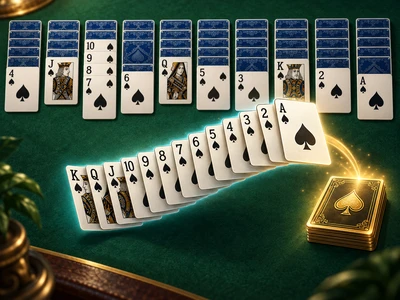
Spider Solitaire (1 Suit)
Spider Solitaire (1 Suit) is a one-player card game played with two 52-card decks in which every…
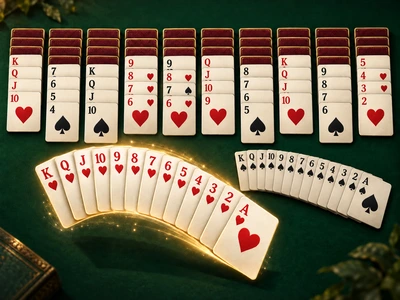
Spider Solitaire (2 Suits)
Spider Solitaire (2 Suits) is a one-player card game played with 104 cards in just spades and…
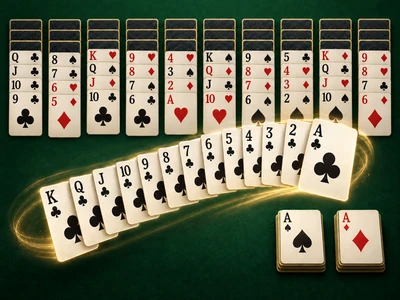
Spider Solitaire (4 Suits)
Spider Solitaire (4 Suits) is the full, standard game: 104 cards from two decks, with 26 each of…
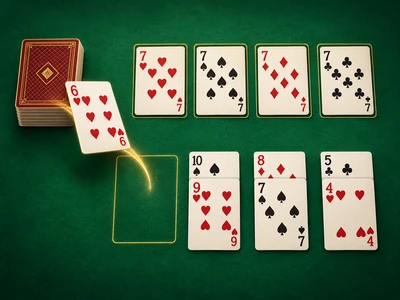
Canfield Solitaire
Canfield Solitaire is a one-deck game for one player.

Clock Solitaire
Clock Solitaire is a one-deck patience: 13 face-down piles of 4, twelve round a clock face and the…
Double Klondike Solitaire
Double Klondike, also known by its classic name Gargantua, is a one-player solitaire played with…
Forty Thieves
Forty Thieves is a two-deck, one-player solitaire.
FreeCell Solitaire
FreeCell Solitaire is a one-player card game played with a single 52-card deck, dealt face up into…