
Loading…
Rotate for the best fullscreen experience
Spiderette is Spider with a single deck: 52 cards in seven Klondike-style columns of 1 to 7 cards, only the bottom card of each face up. You stack down by rank in any suit, but only a same-suit run moves as one piece, and a same-suit King-to-Ace run of 13 is taken away. The 24-card deck is dealt in four rounds, and the last one has only 3 cards, for columns 1–3.
At a glance
| Players | 1 |
|---|---|
| Decks | 1 |
| Jokers | No |
| Difficulty | Hard |
| Computer opponents | No |
How to play
The deck, the staircase deal and the table
Spiderette uses one standard 52-card deck with no jokers. All four suits take part — spades ♠, hearts ♥, diamonds ♦ and clubs ♣ — with 13 cards each, so every suit is exactly one complete A-to-K set. Ranks count as A=1, 2 to 10 at face value, J=11, Q=12 and K=13.
Every face-up card shows both its rank and its suit symbol in the corner, and the symbol is what counts. Spades and clubs are both black, hearts and diamonds are both red, so the same colour does not mean the same suit. 8♠ and 7♣ look like a black pair, but under the rules they are two different suits.
The deal puts 28 cards into seven columns in a staircase, just like Klondike: one card in the first column, two in the second, and so on up to seven in the last. Only the bottom card of each column is face up; everything above it is a face-down card whose rank and suit you cannot read yet. A new game starts with 7 cards visible and 21 face-down cards, all of them stacked up in the right-hand columns.
The other 24 cards stay in the deck and come out in four deals. Each of the first three deals puts one face-up card on every one of the seven columns. The fourth deal has only 3 cards, and they always go to columns 1, 2 and 3; columns 4 to 7 get nothing that round. The status area shows how many deals are left, how many sets you have cleared out of 4, how many face-down cards remain, your move count and your time. The four foundation places mark each cleared set with its suit symbol. Nothing here is a timer counting against you.
Stacking ignores suit, moving a run does not
There are only two kinds of move: move cards between columns, or deal a row from the deck.
Inside a column you build down by rank, and the suit does not matter for stacking: any card may be placed on a card exactly one rank higher. 7♦ may go on 8♠, 7♣ may go on 8♥, and 7♣ may go on 8♠. The bottom card of any column can always be picked up on its own.
Moving several cards at once is stricter. They must form a same-suit run in unbroken descending order. 9♥ 8♥ 7♥ is a run and can travel as one unit onto any 10 or into an empty column. 8♠ 7♣ is in rank order and both cards are black, yet it mixes two suits, so it cannot move together — you have to move the 7♣ away by itself first. Placing a card on another suit is always legal, but from then on those cards no longer move as one block, and they have to be taken apart card by card later.
An empty column is the most valuable thing on the table. Any card, or any same-suit run you are allowed to move, can be placed into an empty column — no particular rank or suit is required to start it. With only seven columns, a single empty column often decides how the game goes.
When you move cards away and leave a face-down card at the bottom of a column, that card turns over at once and the face-down counter drops by one. Turning cards over is the only way new information reaches the table.
Dealing: four rounds, and the last one has 3 cards
When you run out of useful moves, tap the deck to deal a row. The first three deals put 7 cards down, one on each column; the fourth puts down 3 cards, on columns 1 to 3 only.
So that the short last round never catches you by surprise, once only those 3 cards are left the deck shows an extra tag, "3→1–3", and a small gold marker appears where they will land on columns 1 to 3. Screen readers hear the same thing: the last deal has only 3 cards, for columns 1–3. After it is dealt, the announcement says 3 cards were dealt, and the deck is greyed out with a note that there are no cards left.
Two conditions apply. You cannot deal while any column is empty — and that includes the last round. Even if the empty column is column 5, where none of the 3 cards would land, you still have to fill it first. And once the deck is empty it stays empty; nothing is reshuffled or recycled. A dealt row lands on top of whatever you have built, in whatever suit it happens to be, so it often breaks a same-suit run; choosing the moment to deal is one of the central decisions of the game.
Completing a same-suit set from King to Ace
The goal of every set is the same: a run of thirteen cards of one suit from K down to A in a single column. The moment such a run appears, those 13 cards leave the table on their own and go to a foundation, the counter moves to "N/4", and the announcement says which suit it was, for example "Set complete ♣, 3 of 4". It does not matter whether the run was finished by a move or by a dealt card. If clearing the set leaves a face-down card at the bottom of that column, it turns over straight away.
Note that a K-to-A column that mixes suits is not taken away, even if the odd card out has the same colour — a single club inside a run of spades is enough to stop it.
Each suit has exactly one set, and four sets of thirteen make 52, so clearing one set each of spades, hearts, diamonds and clubs empties the table and wins the game. Because the four sets use every card, all four deals must be dealt before the last set can be completed.
Controls: tap, drag and the segment picker
There are three ways to move cards, and one press can only ever be one of them.
- Tap a face-up card and the run from that card to the bottom of the column moves at once to the best target. The order is fixed and predictable: a target that completes a same-suit King-to-Ace set, then a card of the same suit one rank higher, then any other legal non-empty column (a card of another suit), and only then an empty column, with the lowest-numbered column breaking a tie. If 7♣ could go on either 8♠ or 8♣, a tap picks 8♣. If the card you tap has a card of another suit below it, nothing moves and a short line explains that only a same-suit run in order can move together.
- Drag a card and its run follows your finger or pointer; drop it on the column you want. Dragging is the most direct way to put a card on another suit on purpose. An illegal drop springs back and changes nothing.
- Press and hold a column (or right-click it, or focus it with the keyboard and press Enter) to open the segment picker. It enlarges the column so you can read the rank and suit of every face-up card, lets you choose with ▲ and ▼ how many cards to take — it only stops on runs that can actually move — and lists every legal target, marking any that would complete a set and any empty column. Confirm to move; cancel, Esc or a tap outside changes nothing.
The segment picker is also how you read long columns. Column 7 starts with six face-down cards, and once mixed suits pile up below them, a phone in portrait has to overlap that column tightly. When that happens the column is marked as dense, its bottom card stays fully readable, and the picker shows the rest at full size.
Illegal actions never change the position and never pass silently: moving a block that mixes suits (including two suits of the same colour) or has a gap, dropping on a rank that does not fit, or tapping the deck while a column is empty or after the last deal each bounce back with a short line saying why.
Undo, hints and the end of a game
Undo is unlimited and covers everything: an ordinary move, a dealt row (including the last 3 cards, which go back on the deck in order and bring the "3→1–3" tag back), and even a cleared set, which returns to its column. If a move had turned a card face up, undoing it covers that card again. What you have seen never rolls back: a card that has once been face up stays known for the rest of the game, so hints are never more cautious than your own memory.
The hint button suggests a move worth making, in a fixed order: first a move that turns over a face-down card, then one that empties a column, then one that completes a same-suit set, then one that joins loose cards into a longer same-suit run without breaking one you already have. Putting a card on another suit does not count as progress, so if that kind of stacking and shuffling back and forth is all that is left, the hint says there is no progress to be made on the table and points to the next real step: deal a row, fill the empty column first and then deal, or undo a few moves or start a new game. It is a nudge, not a defeat.
There is one deliberate restraint. While any face-down card or any card still in the deck has not been seen, the game will never tell you the deal is lost — and the last 3 cards stay hidden until they are dealt, like the rest of the deck. Only when every card is known can a hint state that this game cannot be finished from here, and even then it appears as a bar with a way out (replay the same deal or take a new one). It never ends your game for you. While a check is running the bar shows a checking state and the table stays fully responsive.
If the deck is empty and no legal move exists at all, the game really is over and the result panel says so, offering to undo the last move, replay the same deal or start a new one. When you clear the fourth set, the result panel shows your time, your moves, the sets cleared per suit ("♠ 1 · ♥ 1 · ♦ 1 · ♣ 1 (4/4)") and the deal identifier, which you can copy with a tap to replay the very same cards. The keyboard covers the whole game: U undoes, H asks for a hint, N starts a new deal and D deals a row; the left and right arrow keys move between columns, Enter or Space opens the segment picker, and Esc closes it.
About this game
Spider with one deck
Spiderette, also called Spiderette Solitaire or One-Deck Spider, is the single-deck member of the Spider family. Standard Spider uses two decks, 104 cards and ten columns; Spiderette shrinks that to one deck and borrows the seven-column staircase from Klondike, while keeping the Spider rules: stacking ignores suit, only same-suit runs move together, and only a same-suit King-to-Ace run leaves the table.
Fewer cards also means a shorter game. There are only four sets to clear and four deals to make, so a game usually takes around ten minutes — easy to fit into a break.
Fewer cards, but not easier
It is tempting to think one deck makes things simpler. In practice Spiderette is generally considered harder than one-suit Spider, for three reasons.
First, all four suits are in play and each suit has only one set. The card you need to continue a run exists exactly once in the whole deck, and it is often still face down or in the deck. Most of the time the card you can reach is in another suit, and every off-suit placement is a small loan: it frees a card or turns one over now, but leaves a join that you will have to take apart card by card later.
Second, empty columns are scarce. There are only seven columns, and the 21 face-down cards sit on the right, with six of them under column 7 from the start. Emptying a column usually means digging through the shallow left-hand columns — which are exactly where the last 3 cards will land.
Third, there are only four deals and the last one is incomplete. Columns 4 to 7 receive nothing in the final round, so thinking ahead about how that round will change columns 1 to 3 is a skill unique to this game.
How it differs from other solitaire games
Klondike and FreeCell both ask you to build alternating red-and-black sequences and to move cards onto foundations one at a time. Spiderette works the other way around: stacking ignores colour entirely, and a set leaves the table only when all thirteen cards of one suit are stacked in one column in order.
Compared with standard two-deck Spider, Spiderette has fewer cards, fewer columns and only four deals, so each decision weighs more. One empty column, or the timing of a single deal, is often what decides the game.
Strategy tips
- Turn over face-down cards first, starting on the right. Columns 5 to 7 hold most of the hidden cards, and a move that reveals one is almost always worth more than a tidy move that reveals nothing.
- Read the symbol, not the colour. ♠ and ♣, ♥ and ♦ share a colour, which is the easiest way to think a run is connected when it is not.
- Prefer the same suit when you have a choice. A card often has several possible homes; take the one in its own suit so the run can still move later.
- Keep an empty column as long as you can, but fill it before you deal. It is your only workspace and the only way to sort out a column of mixed suits.
- Plan for the last round. When only 3 cards are left, columns 1 to 3 will each get one unknown card. If a nearly finished same-suit run sits there, move it to columns 4 to 7 first, or finish the moves you can before you deal.
- Do not bury a King. A K can only start a run, never sit on another card, so a K with cards on top of it is dead weight until you clear it.
- Undo instead of grinding. Undo is unlimited and covers deals too, so stepping back to where things went wrong costs you nothing but time.
Is every game winnable?
No. Spiderette is a one-deck game with all four suits, short same-suit runs and few empty columns, and some deals cannot be finished no matter how well you play — with nothing at the start to tell you which. That is normal and not a reflection of your play. The exits are always there: undo as far back as you like, replay the same cards with a new plan, or start a new deal. The clock pauses when you switch tabs, and rotating your phone, resizing the window or going full screen all keep the current game exactly as it stands.
Spiderette · FAQ
What are the rules of Spiderette?
One 52-card deck is used. Twenty-eight cards go into seven columns of 1 to 7 cards, with only the bottom card of each column face up. You build down by rank regardless of suit, move only same-suit runs together, and fill an empty column with any card or movable run. The remaining 24 cards are dealt in four rounds — 7, 7, 7 and then 3 cards for columns 1 to 3 — never while a column is empty. A same-suit K-to-A run of thirteen cards leaves the table automatically, and clearing one set of each suit wins.
Why does the last deal in Spiderette have only 3 cards?
Because 24 cards do not divide evenly into seven columns. The first three deals use 21 cards, and the 3 that are left go to columns 1, 2 and 3 in the fourth deal, while columns 4 to 7 get nothing. When only those 3 cards remain, the deck shows a "3→1–3" tag and columns 1 to 3 show where they will land, so you can plan ahead.
Can I put a club on a spade in Spiderette?
Yes. Stacking only looks at rank, so 7♣ on 8♠ or 7♦ on 8♥ is legal. The catch is that the two cards are different suits, so they cannot move together afterwards and do not count toward the same King-to-Ace set.
Why can't I deal a row in Spiderette Solitaire?
Because a column is empty, or the deck has run out. Every one of the seven columns must hold at least one card before the deck will deal, including the last round of 3 cards. Fill the empty column with any card or same-suit run, then deal.
Why wasn't my King-to-Ace column removed in Spiderette?
Because the thirteen cards include more than one suit, even if the odd card has the same colour. A set is taken away only when all thirteen are the same suit, from K down to A without a gap.
Is One-Deck Spider easier than two-deck Spider?
No, it is usually considered harder. Spiderette has only seven columns and four deals, each suit has a single set, so the card you need exists only once, and empty columns are harder to make. One deck makes the game shorter, not easier.
Can every Spiderette game be won?
No. Some deals cannot be finished whatever you do, and you cannot tell at the start. Unlimited undo, replaying the same deal and starting a new one are all one tap away, so a hard deal costs you nothing.
Will a hint tell me a Spiderette game has no solution?
Only when it can genuinely know. While any face-down card remains or any card in the deck has not been seen, hints stick to what is visible and say there is no progress left rather than claiming defeat. Once every card is known, a hint may say the game cannot be finished from here and offer to replay the same cards or deal new ones.
Related games
Spider Solitaire (1 Suit)
Spider Solitaire (1 Suit) is a one-player card game played with two 52-card decks in which every…
Spider Solitaire (4 Suits)
Spider Solitaire (4 Suits) is the full, standard game: 104 cards from two decks, with 26 each of…
Klondike Solitaire (Turn 1)
Klondike (Turn 1) is the classic single-player solitaire played with one 52-card deck.
Canfield Solitaire
Canfield Solitaire is a one-deck game for one player.

Clock Solitaire
Clock Solitaire is a one-deck patience: 13 face-down piles of 4, twelve round a clock face and the…
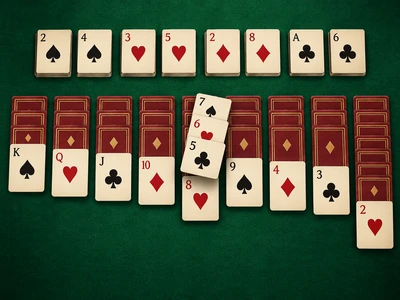
Double Klondike Solitaire
Double Klondike, also known by its classic name Gargantua, is a one-player solitaire played with…
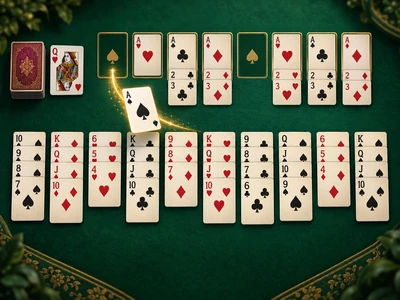
Forty Thieves
Forty Thieves is a two-deck, one-player solitaire.
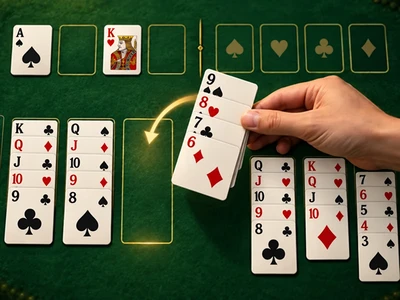
FreeCell Solitaire
FreeCell Solitaire is a one-player card game played with a single 52-card deck, dealt face up into…