
Loading…
Rotate for the best fullscreen experience
Pyramid Solitaire is a one-player game played with a single 52-card deck. Twenty-eight cards are dealt face up into a seven-row pyramid, with the stock and the waste pile below it. Remove any two uncovered cards that add up to 13; a King is 13 on its own. You get three passes through the stock, and clearing all 28 pyramid cards wins the deal.
At a glance
| Players | 1 |
|---|---|
| Decks | 1 |
| Jokers | No |
| Difficulty | Medium |
| Computer opponents | No |
How to play
The deck and the opening layout
Pyramid Solitaire uses one standard 52-card deck with no jokers. Card values are what you would expect: an Ace counts as 1, number cards count at face value, a Jack is 11, a Queen is 12 and a King is 13. Suits and colours play no part in this game at all — only the numbers matter.
The deal starts with 28 cards arranged in seven rows: one card at the apex, two in the next row, and so on down to seven cards along the base. Every one of those 28 cards is face up, and even the covered ones leave a corner showing, so you can read the whole tower from the first second. Each card is held down by the two cards below it, and that overlap is what turns a simple arithmetic puzzle into a planning game.
The remaining 24 cards sit under the tower as the stock. The top stock card is turned face up and can be paired straight away; cards you turn past land on the waste pile next to it, where only the topmost card stays in play. The counter beside the stock shows how many cards are left and which pass you are on.
Removing pairs that add up to 13
Three places hold playable cards: the uncovered cards in the pyramid (a card is uncovered once both cards below it are gone), the face-up top of the stock, and the top of the waste pile. At the start of a deal the seven cards in the bottom row are all uncovered.
There are only two ways to remove cards:
- Any two playable cards whose values add up to 13 leave the table together. That means 10 with 3, 9 with 4, 8 with 5, 7 with 6, Jack with 2 and Queen with Ace. The three sources mix freely: two cards from the tower, a tower card with the stock top or the waste top, or the stock top with the waste top.
- A King is already 13, so it goes on its own with a single tap — no partner needed.
Tap a card to select it and the table highlights every card that can make 13 with it; tap one of them to complete the pair, or tap your card again to deselect. If you pick two cards that do not total 13, tap a card that is still covered, or try to turn a card when the stock is empty, the move bounces back with a short line explaining why — those two do not add up to 13, that card is still covered, no cards left to turn. The position never changes on a rejected move, so a mis-tap costs you nothing.
Cards removed from the tower are gone for good, so every pair is worth a second of thought: which cards does it uncover? The status bar keeps a running "cleared N of 28" so you always know how far the tower still has to fall.
The stock, the waste pile and recycling
When nothing on the tower pairs up, turn the stock: the top card moves to the waste pile and the next one appears face up. Once the stock runs dry, the Recycle control lights up and flips the whole waste pile back over to form a fresh stock, which starts the next pass.
A deal gives you three passes in total, so you can recycle twice. The "pass N of 3" readout is your reminder of how much road is left. When recycling is not available the control is greyed out and still tells you why if you press it: recycling unlocks once the stock is empty, no recycles left, or nothing in the waste to recycle. Because the passes are limited, deciding whether to pair a card now or leave it on the waste top waiting for a better partner is the real skill of this game.
Controls and keyboard
The entire game is played with taps: tap a card to select, tap a second card to make 13, tap a King to clear it, tap the stock to turn a card, tap Recycle to start the next pass. There is no dragging, so a deal plays comfortably one-handed on a phone.
Four controls sit under the table: Undo, Hint, New deal and Rules, the last of which jumps to this how-to section. On a keyboard, U undoes, H asks for a hint, N deals a new game, D turns a stock card and R recycles; the arrow keys move focus between uncovered tower cards, Enter or Space selects and confirms, and Esc clears a selection or closes a hint.
Undo is unlimited, and it covers turning cards and recycling too — undo a recycle and the pass counter steps back with it. The one thing that never rewinds is what you have already seen: a stock card you have looked at stays known to the game, and hints will not pretend otherwise.
Winning, getting stuck, and hints
Clearing all 28 pyramid cards wins the deal, no matter how many cards are still sitting in the stock or on the waste pile — that is the rule used by mainstream web and digital versions. The result panel lists your time, move count, cards cleared and the identifier of the deal you just played; tap the identifier to copy it. The exits are a new deal, a replay of the same deal, and a look back at the board. There is no clock pressure and no penalty for losing.
If you reach a position with no legal move at all — nothing adds up to 13, no King to clear, stock empty and no recycles left — the game says so directly and offers three exits: undo the last move, replay this deal, or deal a new one. There is always a way forward; you never have to reload the page to keep playing.
The Hint button points out a move worth making and highlights it on the table; when the tower has nothing to pair, it tells you to turn a card instead. One restraint is deliberate: while any stock card has not yet been seen, the game will never tell you that a deal has no solution, because it is not going to peek at cards you have not turned. Until then hints stay with what is visible. Once all 24 stock cards have been face up at least once, the whole deck is known to you as well, and from that point a hint will say plainly that there is no solution left from here, together with four exits: undo, hint, replay this deal, or another deal. It never declares a loss for you and never ends the game on its own. On a tangled position the hint bar shows "checking for a solution" first and the table stays responsive; if no verdict arrives in time you simply get an ordinary suggestion, never a false claim that the deal is dead.
Switching tabs pauses the timer and returns you to the same clock. Rotating the phone, resizing the window or going in and out of fullscreen keeps the current deal exactly as it was.
About this game
Where Pyramid Solitaire comes from
Pyramid Solitaire is one of the most widely played matching patiences in the traditional card-game canon. The English name comes from the seven-row tower on the table, and the game has picked up a few nicknames along the way: Tut's Tomb, which casts clearing the tower as opening a pharaoh's burial chamber, and Pile of 28, which simply counts the cards. The rules are about as small as a card game gets — if you can add to 13, you can play.
Computers spread it further. It travels in almost every solitaire collection, and today nearly every card-game site carries a version. The differences between implementations come down to two things: how many passes you get through the stock, and whether clearing the tower is enough to win or the stock has to go as well. This site plays the version common to web and digital releases: three passes, and clearing the pyramid wins.
How it differs from other solitaire games
The first difference is arithmetic instead of stacking. Klondike and FreeCell ask you to build long descending runs in alternating colours; Pyramid has no such layer. Cards never move to a new home — they either make 13 and disappear, or they stay put. That is why new players pick it up in a couple of minutes.
The second difference is the order in which the tower comes apart. Every card is pinned by the two beneath it, so the hard part is not spotting a pair that makes 13, it is choosing which pair to take. Some removals uncover two new cards at once; others burn a valuable partner for nothing, and a few moves later the difference shows.
The third difference is a limited number of chances. The stock runs three times and the waste top can be buried by the very next card you turn, so "take it now or save it for a better partner" is a decision you make on every pass. Where Klondike lets you keep cycling for luck, Pyramid puts a hard fence around it.
Why it keeps you playing another deal
A deal takes roughly six to ten minutes and the rhythm is brisk: read the tower, take a pair, watch it get shorter. It asks for very little setup and still leaves the pleasant itch of "if I had taken the other card there…" — and because undo is unlimited, you can actually go back and find out.
It is worth saying plainly that not every deal can be cleared. Drawing a stubborn tower is part of the game rather than a sign you played badly; under the strictest traditional rules this family has always had a low completion rate. That is exactly why landing the apex card feels good, and why starting a fresh deal costs you nothing.
Strategy tips
- Read the base before the apex. Look along rows six and seven first for pairs that already make 13 — that is where the tower can start coming down.
- Prefer the pair that uncovers two new cards. Two removals are two removals, but the one that frees two fresh cards is worth far more.
- Do not hoard Kings. A King clears on its own, and while it sits there it only blocks the card underneath it.
- Watch out for burning partners. There are only so many Aces, Queens, Jacks and twos; before pairing the stock top with a tower card, check whether the tower needs that value more.
- Neighbouring pairs are usually safe. Two adjacent cards in the same row that add up to 13 can normally be taken at once, and the card they were pinning becomes an uncovered card immediately.
- Keep a pass in reserve. Clear aggressively on the first pass; by the third you have already seen the whole stock order, which is the moment to plan the finish.
- When stuck, undo. Stepping back to a branching point beats grinding through the remaining passes on a line you already doubt.
Pyramid Solitaire · FAQ
What are the rules of Pyramid Solitaire?
Twenty-eight cards from a 52-card deck are dealt face up into a seven-row pyramid and the other 24 become the stock. Remove any two uncovered cards whose values add up to 13; a King, worth 13, is removed on its own. The stock top and the waste pile top can be paired as well. Clearing all 28 pyramid cards wins.
Which cards can I play in Pyramid Solitaire?
Three of them at any moment: the uncovered cards in the pyramid — those with both cards below them already removed — plus the face-up top of the stock and the top of the waste pile. Covered cards will not respond, and tapping one tells you it is still covered.
How do card values work in Pyramid Solitaire?
An Ace is 1, number cards are face value, a Jack is 11, a Queen is 12 and a King is 13. So Ace pairs with Queen, 2 with Jack, 3 with 10, 4 with 9, 5 with 8 and 6 with 7, while a King is already 13 and goes alone. Suit and colour never matter.
How many times can I go through the stock in Pyramid?
Three passes in all. When the stock is empty you can recycle the waste pile back into it, which means recycling twice per deal. The "pass N of 3" readout tracks where you are, and the control explains itself whenever it is unavailable.
Do I have to clear the stock to win Pyramid Solitaire?
No. This version follows the common web rule: removing all 28 pyramid cards wins the deal, however many cards remain in the stock or on the waste pile.
Is every Pyramid Solitaire deal winnable?
No, and that is normal for this family of games — a good number of deals cannot be cleared however well you play. The exits are always there instead: undo as often as you like, replay the same deal, or take a new one, and if no legal move remains the game tells you straight away.
Will a Pyramid Solitaire hint tell me the deal is dead?
Only when it can know. While any stock card is still unseen, hints stick to what is on the table and never claim a dead position. Once all 24 stock cards have been turned face up at least once, a hint that finds nothing will state that there is no solution from here and offer undo, hint, replay this deal and another deal.
Can I undo in Pyramid Solitaire?
Yes, without limit, and that includes turning a stock card and recycling — undo a recycle and the pass counter goes back with it. The only thing that does not rewind is knowledge: stock cards you have already seen stay seen.
How do I play Pyramid Solitaire with a keyboard?
U undoes, H gives a hint, N starts a new deal, D turns a stock card and R recycles. The arrow keys move focus between uncovered tower cards, Enter or Space selects and confirms, and Esc cancels a selection or closes a hint. With a mouse or touchscreen, everything is a single tap — there is nothing to drag.
Why is Pyramid Solitaire also called Tut's Tomb or Pile of 28?
They are nicknames for the same game. Tut's Tomb leans on the Egyptian imagery of dismantling a pyramid, while Pile of 28 is simply a count of the cards dealt into the tower. The rules — pairs that add up to 13, Kings alone — are identical under every name.
Related games
Klondike Solitaire (Turn 1)
Klondike (Turn 1) is the classic single-player solitaire played with one 52-card deck.
FreeCell Solitaire
FreeCell Solitaire is a one-player card game played with a single 52-card deck, dealt face up into…
Klondike Solitaire (Turn 3)
Klondike Solitaire (Turn 3) is the draw-three version of the classic one-player card game, played…
Spider Solitaire (1 Suit)
Spider Solitaire (1 Suit) is a one-player card game played with two 52-card decks in which every…
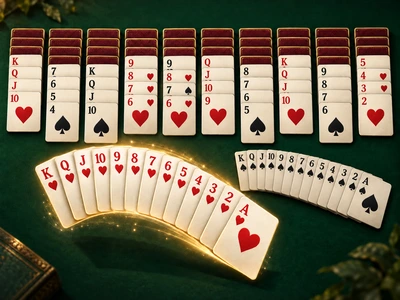
Spider Solitaire (2 Suits)
Spider Solitaire (2 Suits) is a one-player card game played with 104 cards in just spades and…
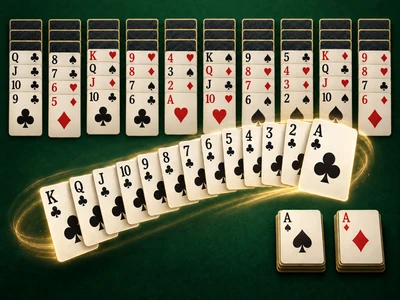
Spider Solitaire (4 Suits)
Spider Solitaire (4 Suits) is the full, standard game: 104 cards from two decks, with 26 each of…

TriPeaks Solitaire
TriPeaks Solitaire is a one-player card game played with a single 52-card deck.