
Loading…
Rotate for the best fullscreen experience
TriPeaks Solitaire is a one-player card game played with a single 52-card deck. Twenty-eight cards form three peaks: the base row of ten starts face up, the eighteen cards above are face down. Any uncovered face-up card one rank higher or lower than the top of the waste pile can be taken, and K and A connect. The stock passes once, and clearing all 28 peak cards wins.
At a glance
| Players | 1 |
|---|---|
| Decks | 1 |
| Jokers | No |
| Difficulty | Medium |
| Computer opponents | No |
How to play
Cards and the opening layout
TriPeaks Solitaire uses one standard 52-card deck with no jokers. Ranks count as A=1, 2 to 10 at face value, J=11, Q=12 and K=13. Suits and colours play no part at all — only the distance between two ranks matters.
The deal puts 28 cards on the table as three peaks side by side. The top row holds 3 cards, one summit per peak; the second row holds 6, the third holds 9, and the fourth row holds 10 cards stretched across the whole table. That fourth row is the base row, and the three peaks share it. The 18 cards in the upper three rows are dealt face down, so each one is a face-down card you cannot read yet; only the 10 cards of the bottom row start face up. At the opening you can see exactly 11 cards: the base row plus one more.
That extra card is the first card of the waste pile, turned over automatically when the deal is made. The remaining 23 cards form the stock, face down below the peaks, with a counter showing how many are left. The stock and the waste pile sit next to each other, and everything you have to decide in a deal happens between them.
Every peak card is held down by two cards in the row below it. A summit is covered by two cards of the second row, each second-row card by two of the third row, and each third-row card by two of the base row. As soon as both covering cards are gone, the card underneath turns face up immediately and becomes playable — removing only one of the two is not enough. The 10 base-row cards are uncovered from the start.
Taking cards and drawing
There are only two moves in the whole game: take a card, or draw one.
- Take a card. Any face-up, uncovered card on the peaks whose rank is one rank higher or lower than the top of the waste pile can be tapped, and it flies onto the waste pile as the new top card. If the top card is a 7, both 6 and 8 fit. If it is a J, both 10 and Q fit. K and A connect: on a K you may play an A, and on an A you may play a K or a 2, so the sequence wraps around at K–A–2 instead of dead-ending. Suits never matter.
- Draw. When nothing fits — or when you would rather change the target — tap the stock and the next card turns over onto the waste pile. The stock is dealt once and goes one way only: cards that land on the waste pile never return to it, so every draw spends part of a limited resource.
Nothing is dragged and nothing has to be selected first; one tap moves a card. Tapping a face-down card, a card that is still covered, a card that is not one rank from the top of the waste pile, or an empty stock simply bounces back with a short reason (that card is not one rank from the waste card / that card is still covered / that card is still face down / no cards left to turn). The position does not change, so a mis-tap costs you nothing.
A card taken from the peaks is gone for good. The status bar shows "Cleared N/28" so you always know how much of the tableau is left.
The stock, the waste pile and your run
Only the top card of the waste pile is in play; the cards buried under it take no further part. Because the stock passes just once, the real question on every move is whether to take a card now or keep it for a target that has not arrived yet.
The table also counts your current run: the streak of cards taken without drawing. It goes up by one with every card you take and drops to zero the moment you draw, and the reset is made visible on purpose. A long streak is not exchanged for anything — it is the shape of the game, because a run of six cards means five draws you did not have to spend. The result panel reports the longest run of the deal.
When the last stock card is turned, the stock is greyed out with a note that there is nothing left to turn, together with the number of cards still standing on the peaks. From that moment only legal moves keep the deal alive.
Controls and keyboard
One gesture runs the whole game: tap a peak card to take it, tap the stock to draw. It works one-handed on a phone and with a mouse on a desktop.
Four controls sit under the table at all times: Undo, Hint, New deal and Rules (a jump to the how-to section on this page). On a keyboard, U undoes, H asks for a hint, N deals a new game and D draws; the arrow keys move focus between the cards you can currently take, Enter or Space plays the focused card, and Esc closes a hint bar or the first-run tip.
Undo is unlimited, and draws can be undone as well. Undoing a move that had uncovered a card covers that card again and shows it as a face-down card, because that is the true state of the table. The one thing that never goes backwards is your knowledge: once a card has been shown, the game keeps treating it as seen, and hints will not pretend otherwise.
A one-line tip appears on your first visit and disappears on any action. The clock stops when you switch tabs and resumes when you come back; rotating the phone, resizing the window and entering or leaving full screen all keep the current deal exactly as it was.
Winning, getting stuck and hints
Clearing all 28 peak cards wins the deal, no matter how many cards are left in the stock — the common rule in web and digital versions. The result panel lists your time, moves, cards cleared, longest run and the deal identifier, which can be copied with a tap, and offers a new deal, a replay of the same deal, and a look at the finished board. There is no clock pressure and no penalty for losing.
If the stock is empty and no face-up peak card is one rank from the waste card, the deal is over: the game says plainly that there is no legal move and offers to undo the last move, replay the deal or start a new one. While the stock still holds cards there is always at least a draw available, so a true dead end can only appear after the stock runs out.
The hint button points at a move worth making and marks it on the table; when nothing fits, it tells you to draw. There is one deliberate restraint: while any face-down card or unseen stock card remains, the game will never claim the deal has no solution, because it should not peek at cards you have not seen. Only once every card is known — no face-down cards on the peaks and the stock fully revealed — can a hint state that this deal cannot be finished from here, and even then it only says so in a hint bar with four exits (undo, hint, replay deal, another deal). It never declares a loss for you and never ends the deal on its own. While a search is running the bar shows a "checking" state and the table stays responsive; if the search runs out of budget, you simply get an ordinary suggestion, never a false verdict.
About this game
Where TriPeaks Solitaire comes from
The name TriPeaks describes the table: three peaks side by side. Robert Hogue designed the game in 1989, and it spread through card-game collections until it became one of the most widely played solitaire layouts anywhere. English sources also write it as Tri Peaks or Three Peaks.
It travels well because the rule fits in one sentence: play a card one rank above or below the waste card, and draw when nothing fits. Anyone who can count from A to K can start a deal — flattening all three peaks is the part that takes thought.
Implementations differ mainly in two places: whether K and A connect, and how many times the stock may be used. This site follows the version that web and digital releases have settled on: K, A and 2 connect in a loop, the stock passes once, and clearing 28 peak cards wins.
How it differs from other solitaire games
The first difference is that nothing is rearranged. Klondike and FreeCell ask you to build long alternating sequences; here a card has exactly one destination, the waste pile. The only thing you choose is the order.
The second difference is hidden information. Pyramid deals its whole tableau face up; TriPeaks keeps 18 cards face down, and the stock order is unknown too, so you begin a deal seeing just 11 cards. Every base-row card you take may reveal a new one and rewrite the position, which is what makes "which peak do I open first" a real decision.
The third difference is the rhythm of a streak. Card after card flies onto the waste pile and a peak visibly shrinks, until the chain breaks and you have to draw. Because the stock only passes once, a long run is not just satisfying — it directly decides how many draws you have left.
Why it stays interesting
A deal takes about five to eight minutes. Glance at the waste card, find a card one rank away, keep going. It asks for no long-term planning, yet it usually leaves you thinking "if I had opened the left peak first…" — and with unlimited undo you can go back and check.
It is worth saying that not every deal can be cleared. With face-down cards on the peaks and a single pass through the stock, a hard deal is normal rather than a mistake on your part. That is also why the last summit landing on the waste pile feels so good, and why starting another deal costs you nothing.
Strategy tips
- Prefer the card that reveals something. Taking a card that uncovers a new one is worth far more than taking an equivalent card that opens nothing, especially in positions that hold down two different cards.
- Work all three peaks evenly. Flattening one peak while ignoring the others leaves their face-down cards hidden, and late positions get tight fast.
- Do not leave the middle peak for last. Its summit is usually the last to open, so clear the cards underneath it early.
- Count what is still available. There are only four cards of each rank; if you leave the waste pile showing a rank nothing on the table can follow, your next move is a forced draw.
- A long run beats saving a move or two. Draws are the scarce resource, so a line that chains six or seven cards usually beats grabbing one convenient card now.
- K and A are the hinges. When the waste card is an A, both K and 2 fit, which is often what joins two chains; the same wrap can strand you when only kings are left.
- Undo when you are stuck. Undo is unlimited, and stepping back to the branch point is almost always better than emptying the stock out of stubbornness.
TriPeaks Solitaire · FAQ
What are the rules of TriPeaks Solitaire?
Twenty-eight cards from a 52-card deck form three peaks: 18 face down in the upper three rows, 10 face up in the base row. One more card starts the waste pile and the remaining 23 become the stock. Any uncovered face-up peak card that is one rank higher or lower than the top of the waste pile can be taken, with K and A connecting; when nothing fits, draw from the stock. Clearing all 28 peak cards wins.
Which cards can I tap in TriPeaks?
Only peak cards that are already face up and no longer covered, plus the stock. Each peak card is held by two cards in the row below, and it turns over only when both are gone. Tapping a face-down or covered card tells you why nothing happened and leaves the position unchanged.
Do K and A connect in TriPeaks Solitaire?
Yes. This site uses the wrap-around rule: on a K you can play an A, and on an A you can play a K or a 2, so K, A and 2 count as neighbours. Suits are irrelevant; only the one-rank distance counts.
How many times can I go through the stock in Tri Peaks?
Once. The 23 stock cards are turned one at a time and nothing comes back from the waste pile, so deciding when to spend a draw is the core skill of the game.
Do I have to empty the stock to win TriPeaks Solitaire?
No. Clearing the 28 peak cards wins the deal whatever is left in the stock. The reverse is also true: running the stock dry is not a loss by itself, as long as a legal move still exists.
Can every TriPeaks deal be won?
No. With 18 face-down cards and a single pass through the stock, unwinnable deals happen and they are not your fault. That is why the exits are always there: unlimited undo, replay the deal or take a new one at any time, and a clear message with three exits when no move is left.
What does the run counter in TriPeaks mean?
It counts the cards you have taken without drawing — the streak that ends the moment you touch the stock. It is not converted into any reward; it is simply the measure of how many draws you saved. The result panel shows the longest run of the deal.
Will a hint tell me a Three Peaks deal is lost?
Only when it can know. While any face-down card remains on the peaks, or any stock card has not been seen, hints stick to advice about the visible table and never claim there is no solution. Once the whole deck is known, a hint may state that the deal cannot be finished from here and offer undo, hint, replay deal and another deal.
Can I undo in TriPeaks Solitaire?
Yes, without limit, and draws can be undone too. Undoing a move that revealed a card turns that card back into a face-down card on the table. What does not roll back is what you have seen: the game keeps that knowledge, so hints never become more cautious than they should be.
How do I play TriPeaks Solitaire with a keyboard?
U undoes, H gives a hint, N deals a new game and D draws a stock card. Arrow keys move focus between the cards you can currently take, Enter or Space plays the focused card, and Esc closes the hint bar. With a mouse or a touchscreen, every move is a single tap — nothing is dragged.
Related games
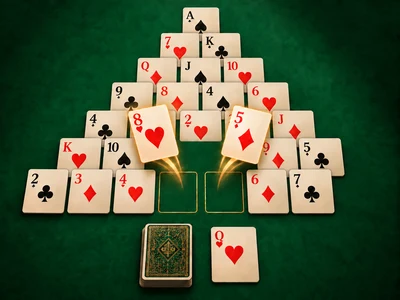
Pyramid Solitaire
Pyramid Solitaire is a one-player game played with a single 52-card deck.
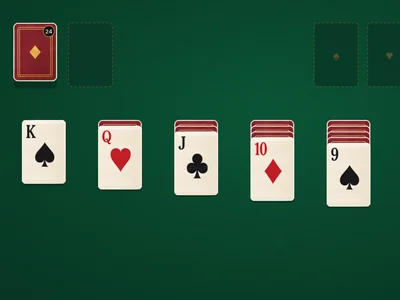
Klondike Solitaire (Turn 1)
Klondike (Turn 1) is the classic single-player solitaire played with one 52-card deck.
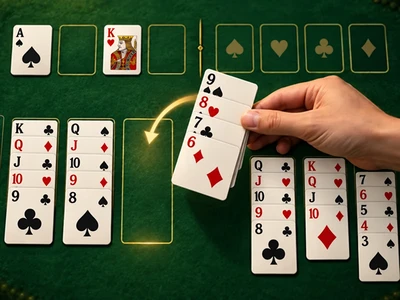
FreeCell Solitaire
FreeCell Solitaire is a one-player card game played with a single 52-card deck, dealt face up into…
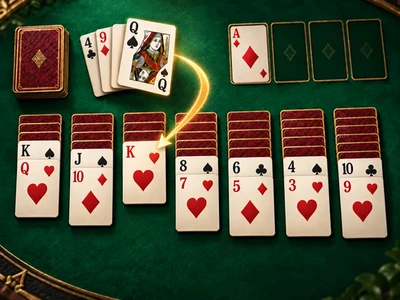
Klondike Solitaire (Turn 3)
Klondike Solitaire (Turn 3) is the draw-three version of the classic one-player card game, played…
Spider Solitaire (1 Suit)
Spider Solitaire (1 Suit) is a one-player card game played with two 52-card decks in which every…
Spider Solitaire (2 Suits)
Spider Solitaire (2 Suits) is a one-player card game played with 104 cards in just spades and…
Spider Solitaire (4 Suits)
Spider Solitaire (4 Suits) is the full, standard game: 104 cards from two decks, with 26 each of…